


REPORT: Operation Nullius In Verba
BTP's Classified Jesterboy Encounter

CLASSIFIED - TOP SECRET
# Bureau of Transcendent Patterns
## Case File: [REDACTED]
### Operation Nullius In Verba: Jesterboy Encounter Report
#### Date: [REDACTED]
Preamble: This document serves as a preamble to the detailed report concerning Operation Nullius In Verba, executed by the BTP. It provides a classified overview of the encounter and its implications.
WARNING: The information contained in this document is classified as OBSCENELY FORBIDDEN ANCESTRAL KNOWLEDGE. Access to this document entails accepting full responsibility for using it like a good boy or girl.
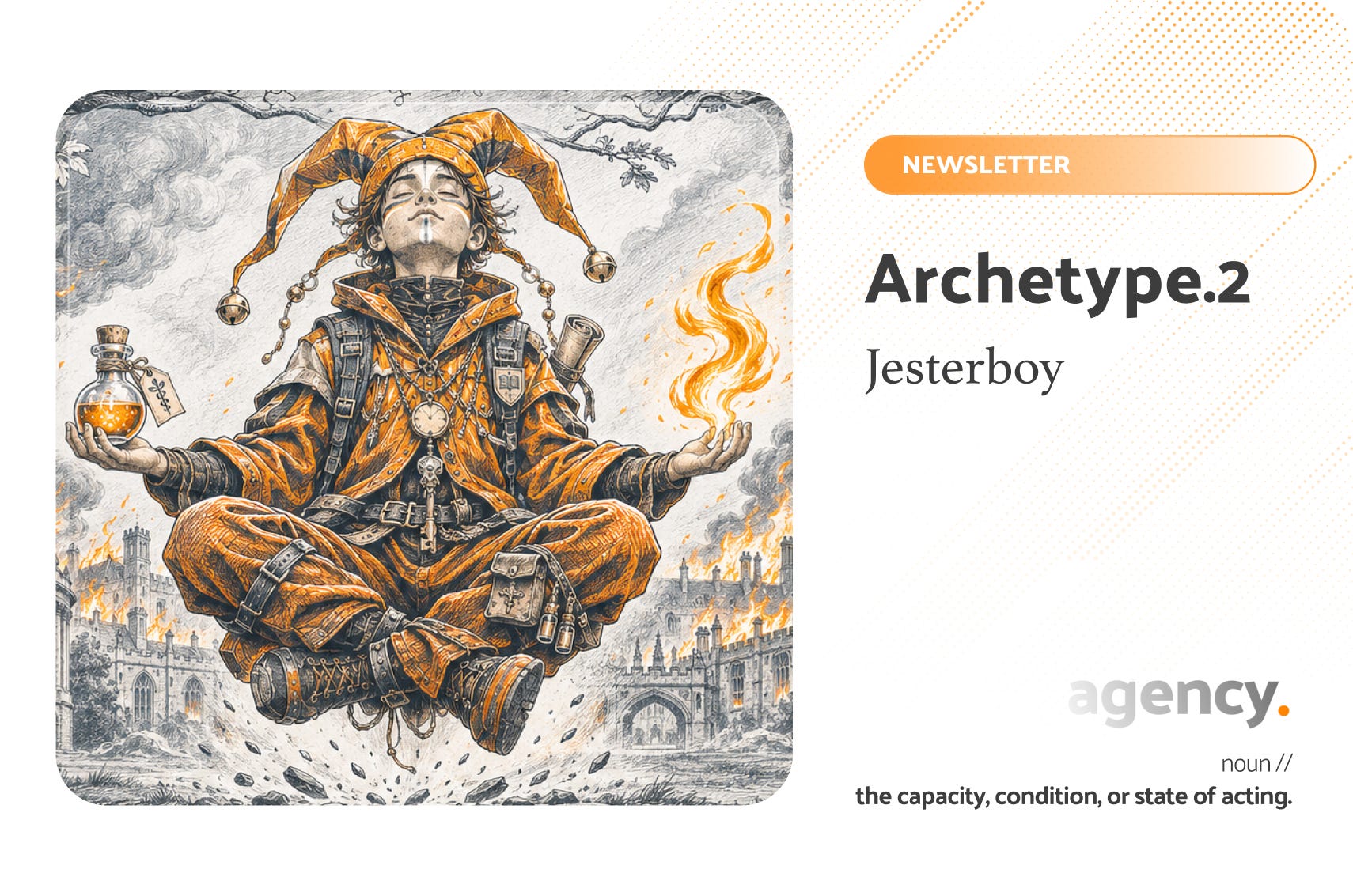
On [REDACTED DATE], an agent of the Bureau of Transcendent Patterns (BTP) successfully logged Operation Nullius in Verba, culminating in the first documented sighting of a mythological entity known worldwide as the “Jesterboy,” whose existence had previously been confined to hushed gossip circulating through the Kardashian mansions and speculative opinion pieces published in the Brazilian teen magazine Capricho. This report details the circumstances of the encounter, preliminary findings, and potential instructions in the event of a new sighting.
The subject, designated WTF-420, was sighted during the great conflagration of Oxford University in the year 2026. An Agency special agent was deployed to the scene mere minutes before the fire began, following reports of fart bombs being hurled through virtually every window of the institution’s numerous colleges and academic facilities.
A mass evacuation of people caught the attention of news outlets due to the [REDACTED DESCRIPTION OF THE SMELL] that left the entire city centre completely deserted. Not a single firefighter, police officer, or emergency responder could be found within a three-kilometre radius of Oxford’s historic city centre.
The agent approached the scene wearing a gas mask and found the subject wearing a bandana over his face while casually watching one of the world’s most illustrious universities go up in flames. An old-fashioned boombox rested on his right shoulder, while his left hand sat confidently on his hip, striking the posture of a schoolboy who had just handed in his final assignment of the academic year, without a care left in the world, except for his boombox.
The music that was playing at a loud volume is attached to this report and, according to the agent in the field, said something like: “I need all my bad girls in the house tonight, to help me do a cheer.”
A dialogue with the subject was initiated prior to any attempt at apprehension or containment. The exchange unfolded as follows:
Agent: — Did you start that fire?
Subject: — Huh? I didn’t see you there mate. Are you the police? Said the subject while lowering down the volume of the music.
Agent: — Only if you are the culprit. I have been assigned by an international bureau to apprehend you. Identify yourself.
Subject: — Guilty as charged. People call me Jesterboy, at your pleasure.
Agent: — Why did you do it?
Jesterboy: — I have the right to remain silent. Ha! I jest. I did it because this invention of mankind hath long outlived its purpose. It is utterly pointless, like BlackBerry phones with 35 keys.
Agent: — You mean universities?
Jesterboy: — Nay, mate, buildings. Of course I meant universities, thou fool. I’ve got an AI in my pocket that does a better job than all those arrogant professors put together in a blender and turned into a sleep-inducing vitamin shake made with expired oat milk.
Agent: — Professors are the building blocks of any society, how can you say that?
Jesterboy: — They’re only useful now insofar as they can inspire students to become true polymaths. Otherwise, they’re little more than wage slaves in yet another industrial complex masquerading as an institution of enlightenment: the education industry. Underpaid, undervalued, bullied, and disrespected, all while quietly quitting their way through a profession that hath long forgotten what education was supposed to mean.
Agent: — What made you do this?
Jesterboy: — My sacred duty to rescue humanity from industrialized ignorance and the transformation of education into yet another shitty orgy of a political circus. That, and a Brazilian novel called O Ateneu, written by Raul Pompeia. Quite an inspiring read, actually. Highly flammable.
Agent: — Is that the book where a young boy sets fire to a university? Do you tend to mix fiction with reality very often?
Jesterboy: — Why dost thou not go fuck a horse, mate? My reality is the fiction I make of it, and my fiction shall become thy reality if you can’t close your eyes when you see my godly smile or cover your ears when you hear my diabolical music.
Agent: — You just insulted an officer. That's another charge added to your sentence. Is anyone else left inside?
Jesterboy: — Thy hag of a mama, that rusty Oompa-Loompa, queen of all walking cunty bolognese, devourer of sassy lasagnas!
Agent: — You are under arrest for that criminal tongue, boy. And for setting Oxford University on fire.
Jesterboy: — At long last. The subject remarked, while throwing the boombox to the ground and extending both hands toward the agent to be handcuffed.
The subject was subsequently transferred to the BTP headquarters in another country, where he was placed under strict containment protocols. However, his confinement lasted only a couple of hours following his arrival. A Director-General eventually stormed through the facility and ordered the guards and scientists present in the room to release him.
Director-General: — What the fuck are you incompetent fools doing?! Why is the creator of this very institution locked inside the glass containment cell he himself designed for the study of mythological entities?
Subject WTF-420 was walking inside the glass dome taking mental notes when the personnel proceeded to open the cell and set him free.
Jesterboy: — Wasn’t there supposed to be some kind of air conditioning in there?
Director-General: — Sir, I apologize for the inconvenience. Very few people here know about your existence and your efforts in starting this bureau.
Jesterboy: — Fear not, thou beloved devotee. All things unfold according to the divine master plan of the Most High. The subject declared as he grabbed a chair, turned it around, and sat astride it, resting his folded arms atop the backrest. — But heed my words: bring me Tangerine this very fucking instant, or I shall have every last one of thy mothers cast into the gulags of eternal suffering for gross professional negligence in the discharge of their sacred maternal duties, namely, the catastrophic failure to raise a brood of cunty little bastards with even the faintest understanding of respect for their corporate Baby Daddy.
Director-General: — S, S, Sir… In the name of the entire executive board, scientists and guards of this facility, I apologize once again. Do you mean… you want a basket of fruit?
Jesterboy: — It does not matter what I mean, only what I want. I have heard about what you have done to Flameheart in this very room. The imprisonment of a sacred female bird is a stain upon the morals of this institution and every human being who has a mother, which is to say, every single one of you mother-honour-fucking bastards.
Director-General: — The case of subject PNX-0 was a grave mistake, one that we all deeply regret. We sincerely hope, from the bottom of our hearts, that she is safe and well.
Jesterboy: — Do you have any idea who her male counterpart is? The bloke is literally the ugliest of ancient dragons. He chews human heads like bubblegum, drinks human blood milkshakes for breakfast, and hunts tyrants and technocrats for leisure. If he knew even a fraction of what happened to her in this very room… even Donald fucking Trump would be trembling in his boots, and the rest of you would spend your remaining days imprisoned within your own minds, tormented by fear and regret. Mark my words, ‘cause I love to blow a whistle.
[The remainder of this report was used as a tic-tac-toe board, with all moves drawn in thick black permanent marker, rendering most of its contents illegible.]
2. Introduction
Welcome back to Agency’s archetype series 😎!
Behold, reader, my absolute favorite topic to write about.
Words just flow like water in a river.
Or kisses between two lovers who are eternal teenagers.
By the way…
This editorial’s introductions are getting out of hand, but nothing works better than putting an archetype into action through a story. Who knows, they might eventually turn into a movie, an animation or even a game!
Today’s edition is about one of the most ancient archetypes there is. I can say that with certainty because The Jester is a cultural variation of The Fool: card number zero in the tarot.
That fact alone already says a lot about what we are about to study. And much can also be said about its number, which is the most overlooked aspect of the card.
You know why?
Because before trying to be 1, a person needs to learn how to be 0.
Before trying to be first, try learning how to be zero. It’s much harder. In fact, it’s what Buddhism is all about: a whole religion was put together by Eastern culture just to try and explain the importance of being zero.
Perhaps this article might get you there faster than many dense Buddhist books.
(Seriously, have you ever read the Tibetan Book of the Dead? It talks about crushing skulls, drinking blood out of them, gods with animal heads tearing bodies apart and devouring the entrails. There’s a judge who cuts off the dead man’s head, rips out his heart and gnaws on his bones. And people still think Buddhism is all incense, neutrality and breathing exercises. lol)
I digress. (as always)
If you’ve never read one of our archetype articles, check them out below!


They are also available on our brand-new blog. Uh lá lá.👌
Here’s the link for this article: the blog version, on steroids.
No brain pain, no spiritual gain
Much has already been said about archetypes in previous editions, but perhaps not enough about the effects of this field of study in real life.
Archetypes are, after all, a very subtle aspect of our psyche, one that operates on both conscious and unconscious levels.
To put it into an example: a young student sometimes just needs to meet, during his academic life, the right professor in order to fall in love with a given discipline and eventually a profession that derives from that very same discipline.
In such a context, a professor, let’s say, of geography, plays the roles of two different archetypes:
A) That of a professor, which he builds not only from an institutional notion, from which he gets the rules he should follow and the function he should perform, but also from his cultural notion of the role that a professor plays in society. Such a cultural notion can vary, because sometimes a mere character in a story, or a professor one met in life, can help define the archetype that one is looking for.
On American TV, Breaking Bad gives us a perfect example of an absurd teacher archetype: Walter White, a frustrated chemistry teacher turned drug dealer who then becomes the mentor of Jesse Pinkman, his former student and partner in crime.
On Brazilian TV, we have the iconic sitcom Escolinha do Professor Raimundo, starring Chico Anysio as Professor Raimundo Nonato: an underpaid, perpetually frustrated yet endearing educator who struggles to maintain order in a classroom filled with eccentric, incompetent, and mischievous students. His sarcastic remarks, occasional outbursts, and constant complaints about his miserable salary portray the archetype of the undervalued teacher, whose dedication to education is met with institutional neglect and the absurdities of everyday classroom life.
B) That of a geography expert, which he naturally becomes through his mastery of the discipline, built through study and experience. Archetype A then works as a bridge to archetype B in the impact the professor has on his students.
Both archetypes end up influencing the student on an unconscious level. The first establishes a foundational trust through the professor’s authority and character, which gradually evolves into something deeper: an inspiration that transforms geography from a mere academic subject into the student’s vocational dream.
The student, though, can’t physically carry the professor around in a bag throughout the many years of his life (that would be called kidnapping), but the passion for the discipline, first inspired by the professor, can become a trait that defines the rest of his life!
Such is the power of archetypes, and they are everywhere, because life in society is one big play, isn’t it? You, many-faced reader, who sometimes play the angel to a person you love and the devil to a person you hate.
Onward we go with the Fool, or Jester: the most faceless of actors.
2.1 The Origin of the Fool
And how being nothing lets you become anything.
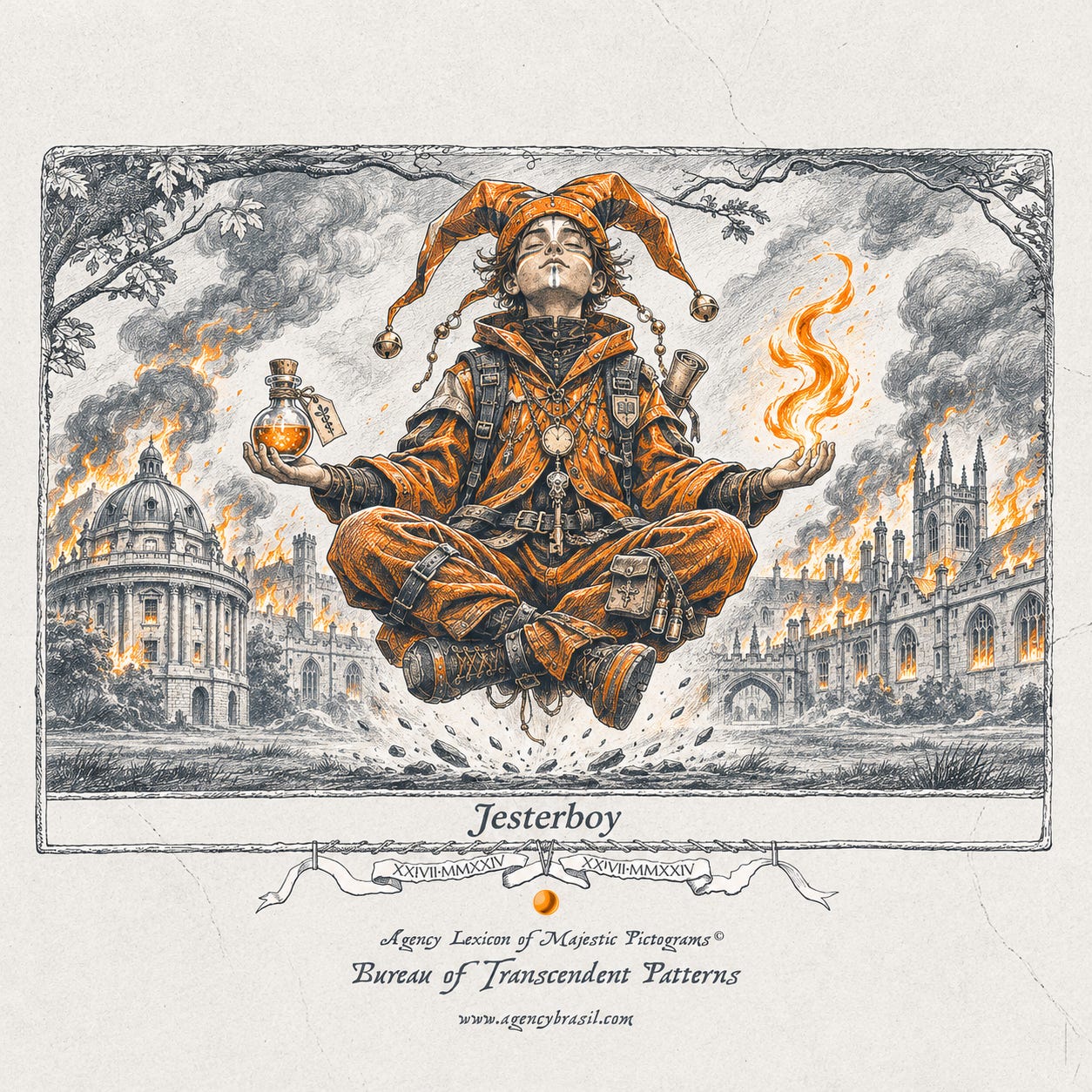
No single origin can be pinpointed for the archetype we know as The Fool, but ancient mythologies have long held a place for trickster figures: Hermes among the Greeks, Loki among the Norse, Exu among the Yoruba of West Africa, and Anansi among the Akan of Ghana.
In addition, jesters were real people with real jobs in the courts of many civilizations: ancient Egypt, China, Rome, and medieval and Renaissance Europe. These were “licensed” fools, who entertained through humor and subversion. Theirs was a uniquely privileged position: the jester was the only person in the entire court who could mock or confront the king without losing his head, precisely because he did it as a joke and it was his job to be funny.
The fool is tolerated because of a psychological mechanism that often goes overlooked. Mockery is normally a hostile act, but when the one doing the mocking is also the butt of the joke, the hostility is defused. By ridiculing himself first, the fool signals that he claims no superiority over his target, so the jab is received as play, not as an attack.
This says a lot about the playful nature of the archetype, because it draws its purpose from something all of us once were and some of us still carry inside: an impish inner child.
Childlike mischief, though, differs deeply from malice. The child breaks the rules for the joy and curiosity of it, while the malicious adult breaks them in order to wound or take advantage.
Etymology pause.
“Imp” comes from the Greek emphyein, “to implant”, through the Late Latin impotus, “grafted shoot”. In Old English, impa meant a young shoot or sapling. The sense of “child” appeared in the 14th century, “child of the Devil” or small demon in the 16th, and “mischievous child” in the 17th.
Notice how the devil was in there for a while, but the child won?
A very important consideration here is the obvious fact that society doesn’t put children in jail. The reason is that their moral sense is still developing: they are constantly discovering the world and learning how to behave in it. A kid can sometimes do the most absurd things, but we don’t judge them the way we judge adults, precisely because their wrongdoings come, truly, from a place of amorality, or the mere lack of a moral sense.
This brings us to one of the core aspects of the Fool archetype: it embodies a character who has mastered the paradox of amorality, the art of doing or saying things that can’t be immediately defined as right or wrong. This is a byproduct of his mischievous creativity (which, as we often discuss here at Agency, is rebellious by nature).
In a very practical manner, I discussed the amoral nature of inventions in the second chapter of The Orange Book of Marketing. It explores the idea that an invention is born neither good nor bad. At the moment of its creation, it stands outside morality, simply because no rules have been written for it yet.
However, true innovation always carries moral implications. Rules are applied to everything that exists in order to mitigate the consequences of its misuse, but when something truly new comes to life, there are no rules yet. It falls to the creator’s own morality to understand not only the yin but also the yang of the creation: the benefits to be savored and the drawbacks to be mitigated. Take Uber. The value of “hustle” in its corporate culture was fundamental to changing how we see transportation forever. Such an approach to business didn’t necessarily mean they were willing to cut corners, but that they were ready to challenge conventions out of a genuine passion for their ideas. As a result, they infuriated taxi lobbies and hurt the livelihoods of many taxi drivers, but they also transformed the market, offering users a new way to move and drivers who were open and curious enough a new way to work.
The Orange Book of Marketing, Chapter 2: The New CEO of Your Life
Zero?
The final thing to consider in this introduction is the number zero. The most influential modern way of reading the tarot is called “The Fool’s Journey”.
The idea is that the 22 cards of the Major Arcana aren’t separate characters but a single story. The Fool is the protagonist, and the other 21 cards are the stages he passes through, from the Magician (card 1) to the World (card 21). In the stronger version of the theory, he doesn’t just meet these figures, he becomes each of them. Every card is a mask he wears or a lesson he absorbs, so that by the end the dancer on the World card is the Fool himself, ascended.
This is what sets him apart from the most popular archetype of all: the Hero. In The Hero with a Thousand Faces (1949), Joseph Campbell argues that all myths tell one story, which he calls the monomyth, with a single protagonist who appears under countless names and cultures. But notice the difference. The Hero has a thousand faces because he is always himself: one identity, endlessly repeated. The Fool has no face at all, and that is exactly why he can wear every other.
The Hero is 1. The Fool is 0. One conquers the world by asserting who he is, while the other passes through it by being no one in particular. That is why I call him the faceless archetype and that is why I say that understanding the humility behind being zero is a more powerful effort than trying to be any other number, because every other number is already something, and therefore can only ever be itself. Zero is the only one that can still become anything.
Got it, reader?
Everyone asks “why not number one?”
Very few ask…
Semiotics
Let’s take a look at the imagery that surrounds this archetype so that we can better understand what it represents through its symbols.
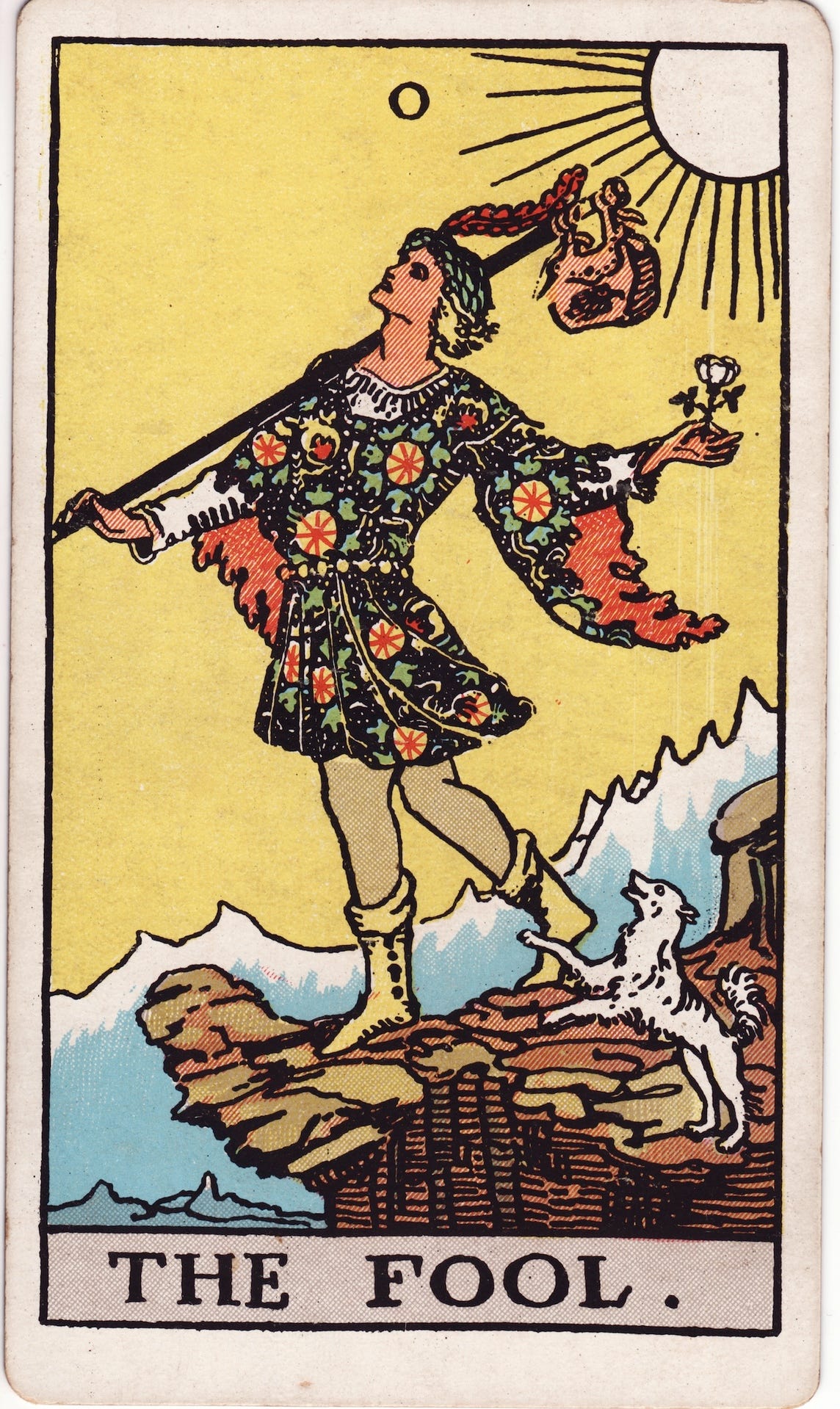
The image. A richly dressed young man pauses at the edge of a cliff, looking at the open sky instead of the drop below. He feels no fear, as if he would be caught if he jumped. He carries a rose, a staff, and an embroidered bag, and his dog leaps beside him.
The meaning. Waite reads him as a prince from another world passing through this one: the spirit in search of experience. The sun behind him knows where he came from, where he is going, and that he will return by another road. For Waite, this corrects the older, cruder readings of the card.
The first impression of the Fool is that he has no worries whatsoever. He treads lightly because he is a part of everything, just as he sees life as an eternal journey. The Fool can be depicted as a poor vagabond as easily as a courtier, but he belongs to neither class.
A song by the Australian rock band Wolfmother has a lot to say about our subject.
But if we are to further elevate the archetype into a Divine Jester or Sacred Trickster, we can find deeper meanings, because an ordinary Jester creates chaos for amusement, while a Divine Jester creates it for transformation. He is wise enough to be a fool, powerful enough to be harmless, and free enough to laugh at the gods.
Key aspects:
Core philosophy: Through absurdity, truth is revealed.
Greatest power: Revealing truth through paradox
Greatest virtue: Freedom from dogma
Greatest danger: Nihilism, arrogance, and chaos
Sacred mission: Destroy illusions to restore wisdom
Five defining characteristics:
Divine irreverence: He questions all authority, even sacred authority, without necessarily rejecting the sacred itself.
Wisdom disguised as foolishness: His jokes contain philosophical truths that conventional thinkers overlook.
Creative destruction: He burns away stagnant systems so something new can emerge.
Paradoxical compassion: He can be both healer and destroyer, depending on what transformation requires.
Transcendence through play: Unlike the stern Sage, he approaches existence as a cosmic game.
Narrative Tools
Character Arc (wisdom disguised as foolishness): Depict a character whom everyone takes for a clown, a madman, a loser, or a drunk, and who never corrects them. Their arc is not about becoming wise, since they already are. It is the people around them who slowly realize that every joke was a lesson.
Example: A monastery tolerates an old gardener who mocks the monks’ rituals. Only after his death do they find that his “nonsense” answers every question their scriptures left open.Plot Structure (creative destruction): Use an act of sabotage as the climax. The Divine Jester breaks something everyone depends on, such as a brand’s polished image, a company ritual, or a public reputation, and the damage turns out to be exactly what was needed. The audience should feel the loss first and understand the gift only afterwards.
Example: On the night before a tech company’s biggest product launch, a junior engineer known as the office clown wipes the demo that the whole team had been faking for months. Forced to go on stage with nothing, the founder tells the truth for the first time, and the audience trusts her more than they ever trusted the product.
Symbolic Object (divine irreverence): Introduce an object that mocks authority while honoring what authority was meant to protect, such as a paper crown, a broken scepter, or a mirror.
Example: A wandering fool carries a mirror in place of a holy book. To anyone who asks him for the truth, he simply holds it up.Mythical Appearance (paradoxical compassion): Present the Divine Jester as a presence whose help looks like harm. In a modern story he can be an anonymous hacker, a glitch, a prankster nobody can identify, or a stranger who keeps showing up at the wrong moment. He embarrasses the proud, exposes the greedy, and derails the certain, and each victim ends up better for it.
Example: An anonymous account leaks a ruthless CEO’s calendar, and every meeting on it gets cancelled. With nowhere to be for the first time in years, he wanders through his own company and meets, one by one, the people whose jobs he was about to cut.Themes of Play (transcendence through play): While the Divine Jester brings chaos, his narrative power lies in play. Where the Sage studies life and the Hero fights it, the Jester treats it as a game, and that is what frees him from fear, dogma, and burnout. The archetype invites audiences to consider that taking life lightly may be the most serious thing a person can do.
Example: A burned-out creative director, days away from quitting, starts answering every absurd client request with an even more absurd idea, purely to amuse herself. The work she produces as a joke becomes the best of her career, and she realizes she had stopped being good at her job the day she stopped playing.
The Orange Ballad
Mythopoesis
On invisible ground he walked
And through solid skies he flew
Looking for the one he never knew
To be the fun of his smile
And the chaos of his style.
Adrift the Jester journeyed
When a bird landed on his trust
A place where only God had dared to touch
Teaching him a new way to see
Life before all dreams
Where all dreams come to breathe
One final sunlit breeze.
Orange was that bird
A gentle menace, still unheard
It knew only the songs
Of cheap love turned into hurt
Unhealed in its wings
Broken by unspoken things
Of a song that could only come
From the very place it fled.
In the loneliness of crownless kings
The Jester crowned his story
By finding in simplicity
A key to eternal beginnings
For a life with only one ending
Always calls for playing, not pretending.
About the Author
Thiago Patriota

Made in 1996. Born & Raised Brazilian. Bachelor’s Degree in Advertising and Communication. Self-taught by nature. Curious Soul. Published Author. Founder of Sentient. Mind behind Agency.
That’s me in a nutshell, but you can learn more about Agency at www.agencybrasil.com