


1. Introduction
How are you doing today reader? Welcome to the new edition of Case.#
Dont forget to check the previous one!

Jan 20th, 2026. Yep, shirtless. Excuse my French. I'm giving the word "nerd" a complete rebrand + nipples out, just to remind everyone that programming today is still the equivalent of a caveman making tools out of rocks. Don't let the suits and vest bros of US Silicon Valley fool you. They've drifted too far from the cave (and their body hair).
Today I’m bringing you a personal project of mine which I have started back in January of this year.
The Mantis Design System is my first authorial design system. It's a work in progress and will stay that way for years. One of my goals is to build it in plain daylight and keep a design diary along the way, because whatever grows in natura doesn't hide in the shadows.
So everything you see here is unfinished and will keep evolving - much like my personality, which never manages to stay the same version for long.
I could be worried about copycats, but if there's one thing I've learned throughout all these years working with creativity, it's that when you cut a flower (or an idea) from its roots, it may retain its beauty for a while, but without the nutrients that sustained it, it eventually withers. Much of what I share here may be copied, but you can't copy the source. 😎
Mantis represents the sum of over 12 years designing websites and apps, ever since the software used for that was Adobe Photoshop with HUNDREDS of layers that were impossible to truly manage and overloaded the memory of any computer.
Photoshop, Adobe XD, Sketch on Macs… In my career I went through all the main sofwares for designing digital experience until Figma finally arrived and became the place for the best work to be done.
At the Uniamérica Keynote, I talked about my journey in UX/UI and one of my first big web design projects.


Mantis came to me when I realized I had mastered Figma and had studied and worked with enough design systems, like IBM's Carbon and many others along the way, to start building a design language of my own. The spark was a product idea I had during an immersion in vibe coding: an IDE (Integrated Development Environment) like VS Code, Cursor, and Xcode for non-nerd peeps.
That period brought an epiphany. Programming and software engineering, once reserved for expensive specialists, had become accessible to almost anyone, kids and grandparents included.
Yet one obstacle remained, and it was surprisingly simple: people are afraid of the terminal and all the quirks of software engineering. Installing dependencies, wrestling with Git, decoding cryptic errors, managing config files, and figuring out deployment.
Software is eating the world (Marc Andreessen, 2011), yet less than 1% of people can code (SlashData, 2025).
If software was already eating the world back in 2011, fifteen years later we're all being digested in its belly. For decades, the software industry has been the spearhead of the economy, of innovation, and of the way we live, work, and relate to one another.
And yet, the people building it are still a tiny minority. Everyone else must spend years learning, spend thousands hiring, or watch their ideas die unrealized. AI is changing that by democratizing engineering FOREVER21! But without orchestration, today’s tools still feel experimental rather than professional.
I’m no expert in economics, but it’s hard to ignore the signs that the AI bubble may be close to bursting. AI providers still haven’t found a solid way to sell their intelligence. Even if subscriptions to AI chats and assistants grew tenfold, they wouldn’t come close to covering the massive, often blind or greedy, investment that tycoons have poured into this new industry.
The real break-even point lies elsewhere: in industrializing the ability to innovate. That means a vibe coding (agentic programming) environment so human that it could be taught in schools or to your grandpa or grandma who is bored watching TV.
An influx of industrial-grade AI consumption driven by ordinary people engineering their own ideas into existence. People running multiple agents, burning through tokens as they build, debug, iterate, and deploy entire applications - a scale of consumption that goes far beyond the occasional interaction with a chatbot. People building their own startups, bringing their dream projects to life, and turning their ideas into businesses capable of sustaining their families, all while finally putting to the test the real capacity of all these data centers that are being built.
That’s the gap I want Mantis to help close. When a new language emerges, like the one this AI era is writing, most people can’t read it yet. It needs a translator. In Human-Computer Interaction, design is that translation.
And beneath all the technical complexities of this new language lies a surprisingly simple idea: that you can build your next source of income - a piece of software of your own - using nothing more than another piece of software on the computer you already have.
My ambition with Mantis is to make that idea feel as natural as it sounds, to design a language through which anyone can exercise their creativity and engineer, autonomously, their own dreams into existence.
And my brush shall be dipped in daylight paint, so everyone can watch this language take shape.
1.1 Design Philosophy
Master intent, not syntax.
Mantis Farm is building tools for creativity - we are a team of tecnophiles (not technocrats) who believe in the potential of the machine in building a reality that is more autonomous and dignified for every human being. It was born in a brainstorm between a Brazilian and an Italian mind - think of it as a day where Ayrton Senna and Giordano Bruno sat down for a talk and they discussed the future of the internet protocol amidst the surge of innovation that NLMs brought to the surface.
The Mantis Design System was born to serve one initial product: Mantis Farm, an agentic IDE where you don't write code, you manage the AI agents that write it for you. We call them Mantises. You decide what gets built, and they plan, write, and ship it. Open source to the bone, built in Brazil on top of General Bots.
Our mission is simple: Give vibe coding an organic spine. Make dreamers…

To design it, I had to go back to 1984.
Before the Macintosh, you used a computer by remembering. You learned the commands, typed them into an empty line, and trusted that something happened. The Mac didn’t make the computer more powerful. It put the computer on the screen: what existed was visible, what you wanted you pointed at, and every program behaved like the one before it.
Forty years later, AI has taken us back to the empty line. A chat box is just a prompt. You have to know what to ask, and everything that matters (which model is answering, what it’s doing, where your files are going, what it costs) hides behind the text.
So the philosophy of Mantis fits in one sentence: replace remembering and asking with seeing and pointing. Intent over syntax. You should master what you want built, not the language or technicalities used to build it.
It’s an entire OS (Operational System) designed with AI agents running in its core. Made with passion for the old and obsession with the new
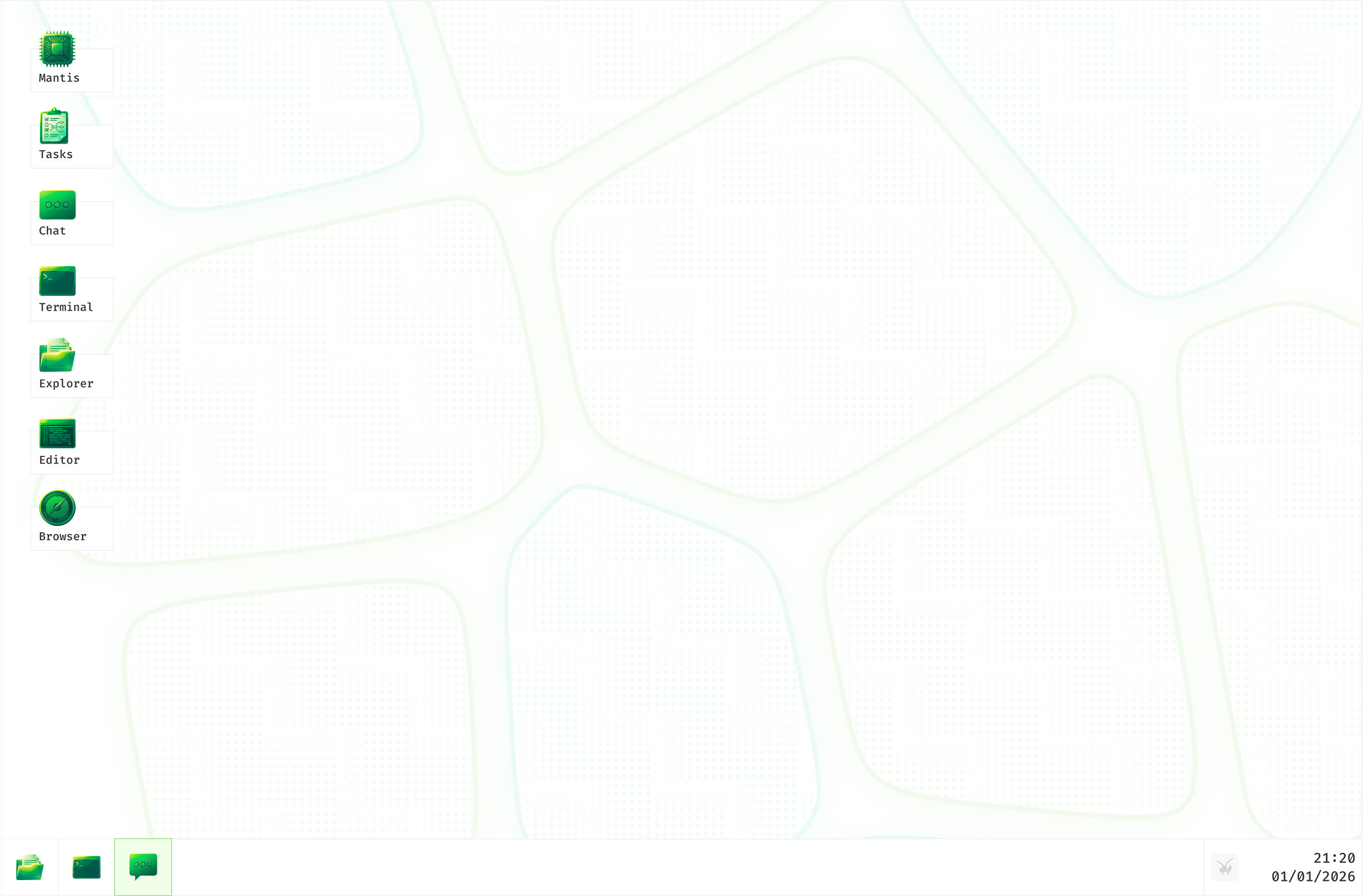
The Vibecoding OS is a desktop, not a chat window. Every project gets its own terminal, editor, file explorer, browser, and task manager, laid out like the computers we already know how to use.
The Mantis Manager shows the machine. Every agent appears on screen with its status, progress, model, and token usage. Nothing important lives only in a sentence.
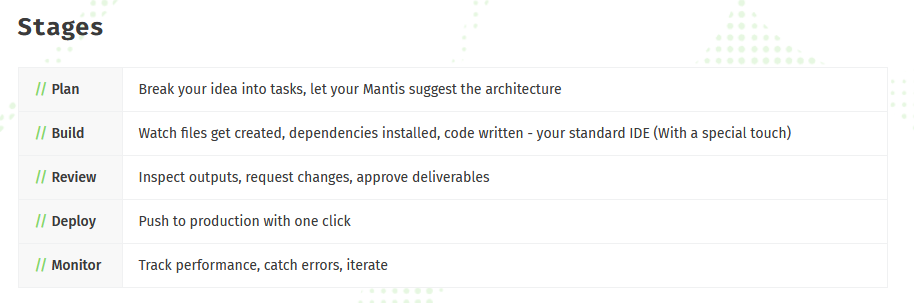
Visual Planning turns a project into a board you can see and touch, moving through Plan, Build, Review, Deploy, and Monitor. Planning becomes playing.
BASIC keywords like TALK, HEAR, SAVE, and SEND make agent workflows readable by anyone, not just engineers. There is something poetic about bringing back the very language that once democratized programming to now democratize the orchestration of AI agents. Passion for the old, obsession with the new.
1.2 Visual Identity
The rigor of code, the patience of nature
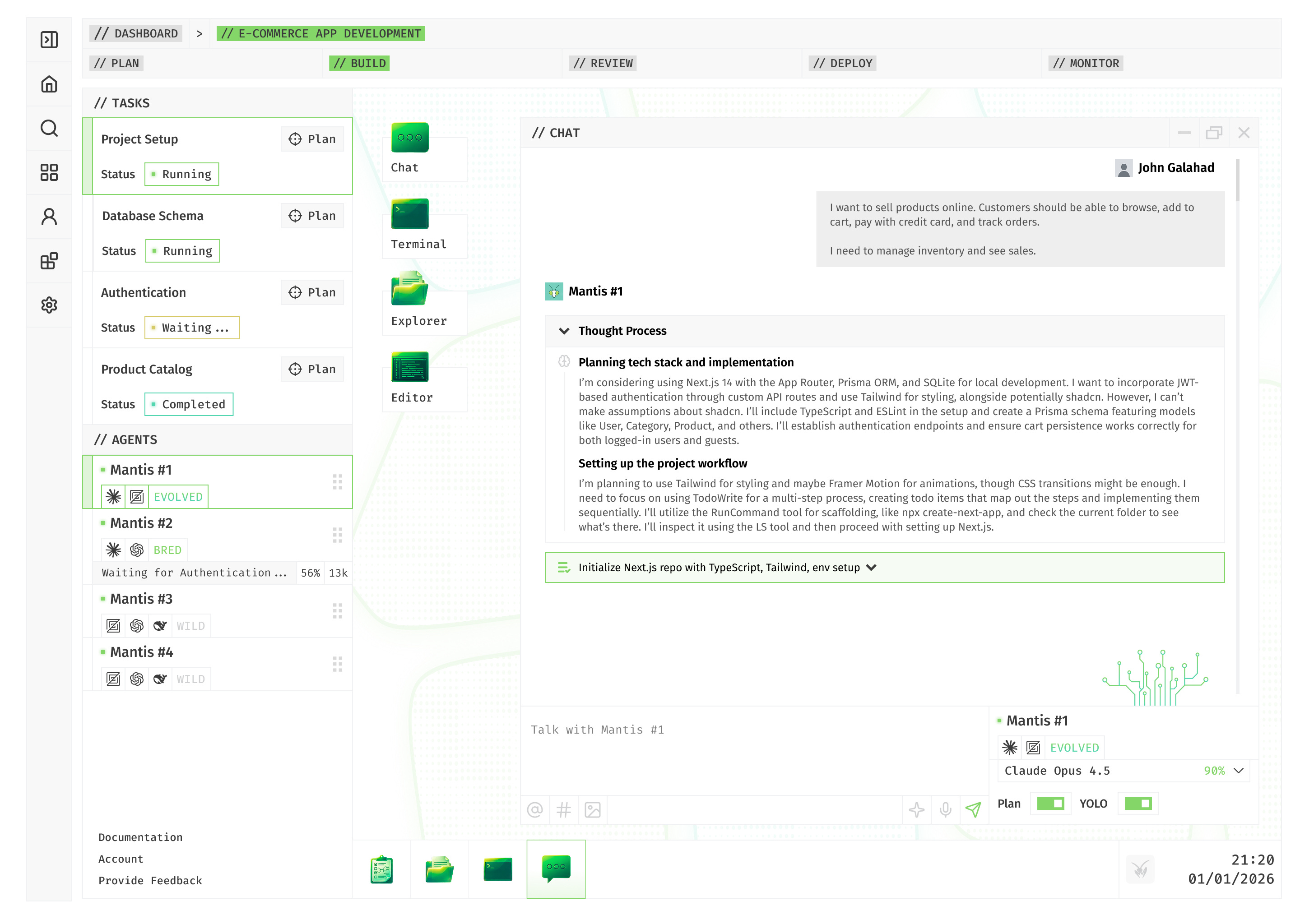
Our mission is to give vibe coding an organic spine, and the visual identity is that sentence made visible. It’s where two things, that rarely share a screen, meet: the rigor of code and the patience of nature.
The spine is code. The interface speaks the language of the people who carried the torch for decades. Every region is named with //, the mark programmers use to leave notes for other humans inside their code. In Mantis Farm, those notes become the map itself. It’s a tribute to the 1% and an invitation to everyone else: you’re already reading code, you just haven’t noticed yet.
The organism is the farm. Code alone is cold, so the system grows in a field. Projects are planted, Mantises evolve from Wild to Evolved, and good patterns become Seeds for others to harvest. The grid isn’t a spreadsheet. It’s soil.
Passion for the old, obsession with the new. The identity looks back on purpose: monospaced type, pixel textures, a desktop you already know how to use. The tools of the past are what make the future feel familiar. What’s new is the agent inside the old frame.
Green means alive. The world of Mantis Farm is daylight: white, grey, and black ink. Green appears only where something is growing, acting, or waiting for you. If it’s green, it’s alive.
The mantis. Patient, precise, camouflaged among the leaves until the moment it moves. That’s the kind of intelligence we want working for you: alive, quiet, attentive, and always waiting for your intent.
1.3 Interface Structure
Hierarchy you can read with your eyes closed
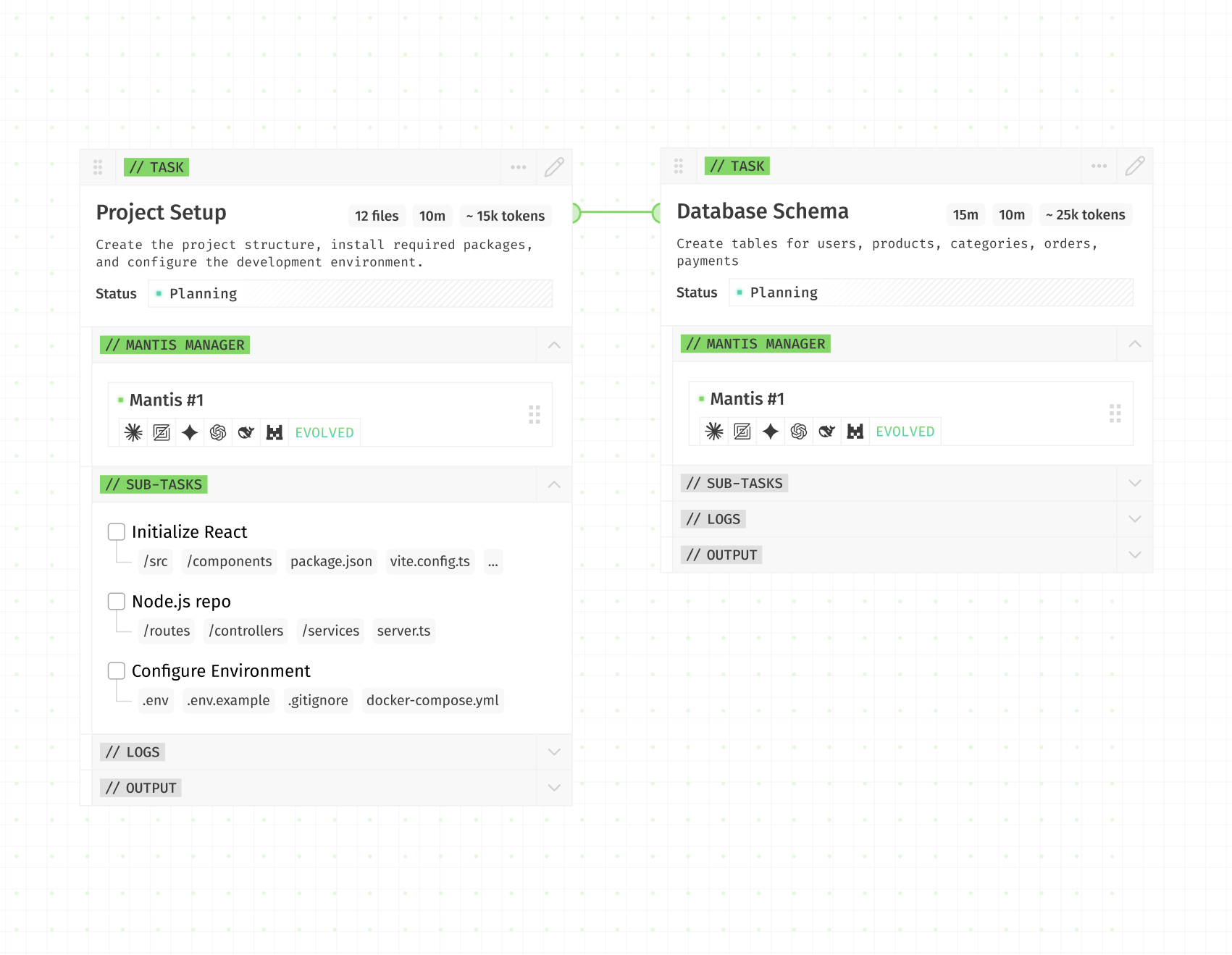
Code has always had a secret: indentation. Long before anyone reads a line, the position of the text already tells you what belongs to what. A block pushed to the right lives inside the block above it. Anyone can read a family hierarchy in the process of understanding a system.
Mantis Farm borrows those secrets and gives it to everyone.
One step in, one level down. Every level of the interface sits one indentation to the right of its parent. A Task holds its Mantis Manager. The Manager holds a Mantis. The Mantis holds its models and its DNA tier. Sub-tasks hold the files they create, connected by thin branch lines, the same way a file tree shows folders. You don’t need a legend to understand it. You just follow the shape down and to the right.
Lines, not boxes. Hierarchy is drawn with a single 1px line and a little space, never with shadows, gradients, or boxes stacked inside boxes. Every line has a job. If it doesn’t explain the structure, it doesn’t exist.
Two voices. The type carries the hierarchy too. Names of things (Project Setup, Mantis #1, Initialize React) are written in a sans serif, like human titles. What the machine says (descriptions, statuses, file names) is written in monospace, like a terminal. At a glance, you know who is speaking.
Open what you need, close what you don’t. Each module is a drawer labeled with //. Green when it’s open and in use, grey when it’s resting. Sub-tasks, Logs, and Output fold away until you ask for them, so a complex project never looks complex all at once.
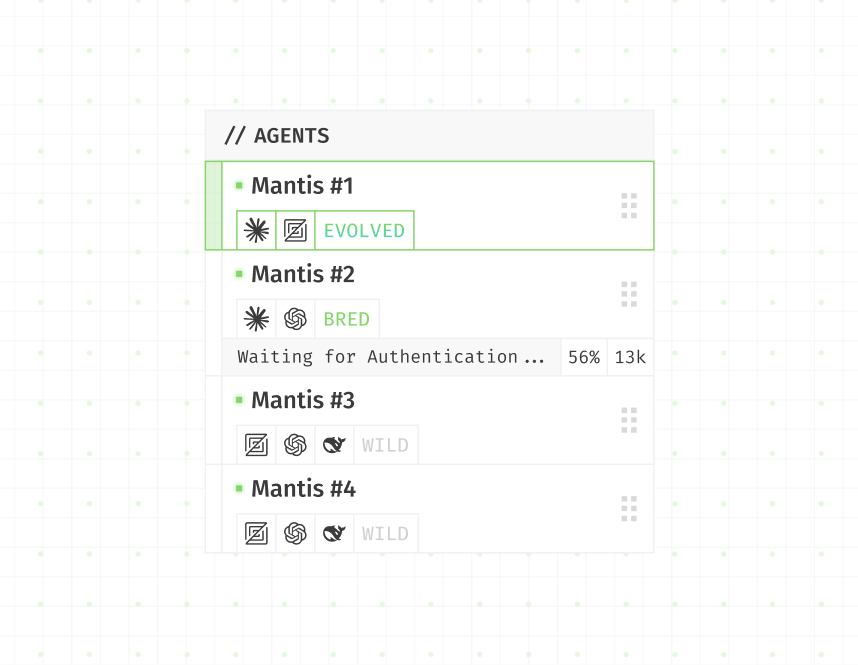
State lives on the object. When Mantis #2 is waiting for authentication, the message doesn’t appear in a pop-up somewhere else. It attaches right below the agent, with its progress and token count beside it. Time, files, and cost sit on the top right of every task. Everything you need to know about a thing is on the thing itself.
Everything can move. The six dots on each card are a handle. Mantises can be dragged into tasks, tasks connected to tasks. The structure isn’t a document you read. It’s a field you rearrange.
The result is an interface that answers "where am I?" before you've read a single word. The shape already told you.
1.4 Navigational Structure
The life of a project
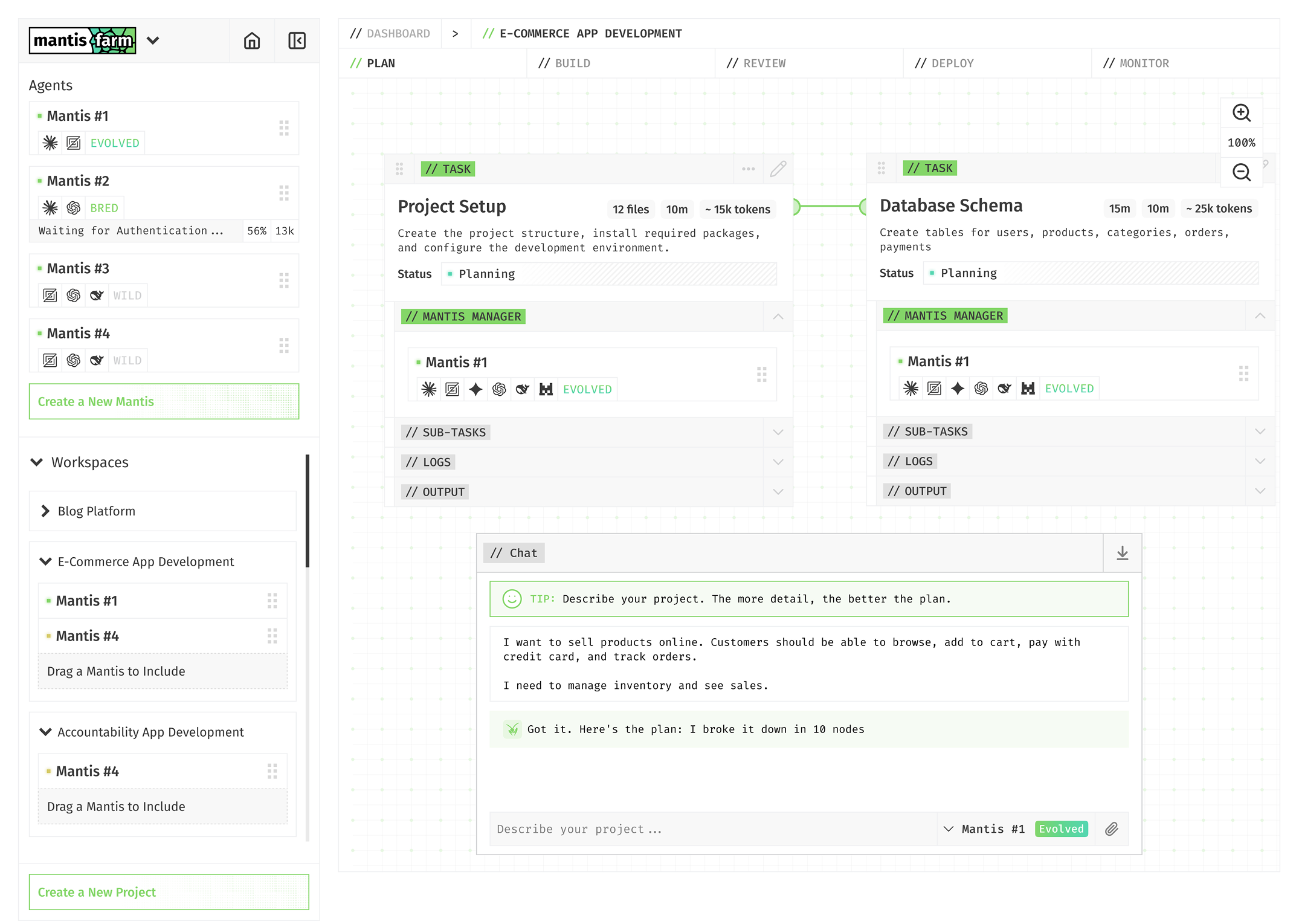
Every piece of software lives the same life. It’s imagined, built, checked, released, and watched over. Most tools hide that life behind menus. Mantis Farm puts it at the top of the screen, as a single line you can read from left to right:
// PLAN › // BUILD › // REVIEW › // DEPLOY › // MONITOR
These aren’t just tabs. They’re the five seasons of a farm. You plan the field, plant and grow, inspect the crop, bring the harvest to market, and keep watching the land. The stage you’re in glows green, and the others wait in grey, so you always know where your project is in its life without asking anyone.
Above the seasons sits the breadcrumb, // DASHBOARD > // E-COMMERCE APP DEVELOPMENT, which tells you where you are in your farm. On the left, the sidebar holds what never changes: your Agents and your Workspaces. Together they form three simple questions the screen always answers: which farm am I in, which project am I tending, and what season is it?
1.5 Agent-First Architecture
Your Mantis, your rules.
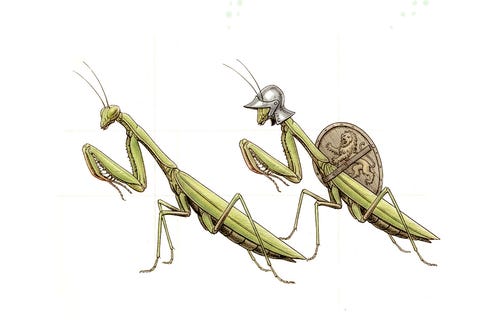
The core competitive differentiator of Mantis Farm lies in its agent-first architecture. Rather than introducing AI as a complementary feature of a conventional IDE, we’re designing the entire experience around the orchestration of intelligence. The primary object of interaction is no longer the code, but the agent that writes it.
Another dimension of our value proposition is the personalization of intelligence. Rather than consuming AI as a standardized commodity, you cultivate it. Every Mantis is born Wild and evolves through Bred and Evolved tiers, allowing for progressive delegation, greater specialization, and eventually multi-agent orchestration through the Swarm Protocol.

This progression model is also a strategy for accessibility and risk mitigation. We wouldn’t put an axe in the hands of a child or a scalpel in the hands of someone who has never studied medicine. Why should we approach artificial intelligence any differently? Whether the user is a twelve-year-old building their first game or a seventy-year-old bringing a lifelong dream project into existence, the experience should accommodate their learning curve. Through progressive disclosure of complexity and graduated autonomy, users can experiment, make mistakes, and develop confidence within controlled operational and financial boundaries.
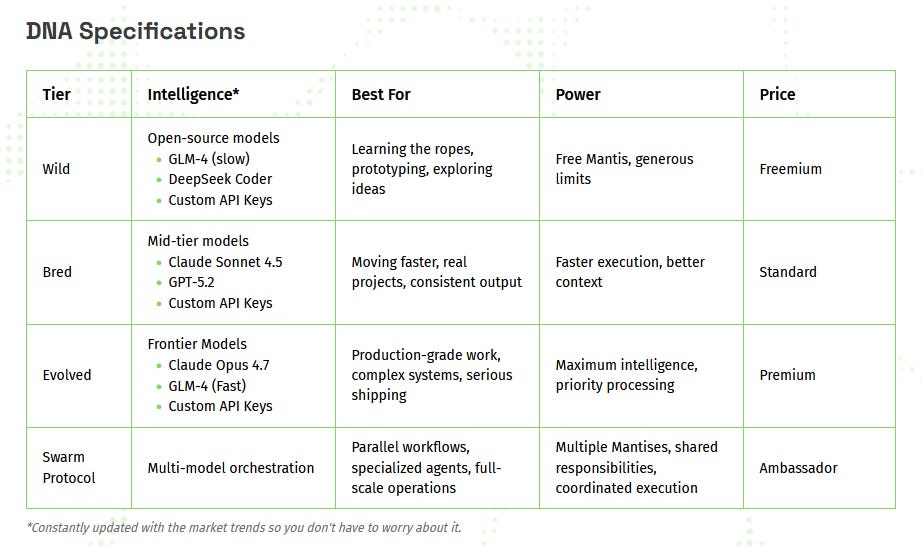
From a product standpoint, this is both an adoption and a retention strategy: a low barrier to entry with a ceiling that grows alongside the user’s ambitions. Much like nurturing talent within a company, rather than expecting to find the perfect employee, you give the wild newbie the opportunity and nutrients to become the absolute best. And in the process of cultivating their intelligence, you cultivate your own.
The farm, therefore, is not merely a branding metaphor. It’s the product’s operational model. Your Mantises plant, grow, and harvest software. You decide what is worth planting.
1.6 Collective Harvest
The intelligence yet to be cultivated.
Much of what we call artificial intelligence today is the result of teaching machines what humanity already knows. But what about teaching them what humanity intends to do with what it knows?
Collective Harvest is our attempt to turn mass AI adoption into a mechanism for learning human intent. Through the BASIC interpreter, successful interpretations of intent are distilled into Seeds, forming a collective vocabulary that grows more resourceful with every successful implementation.
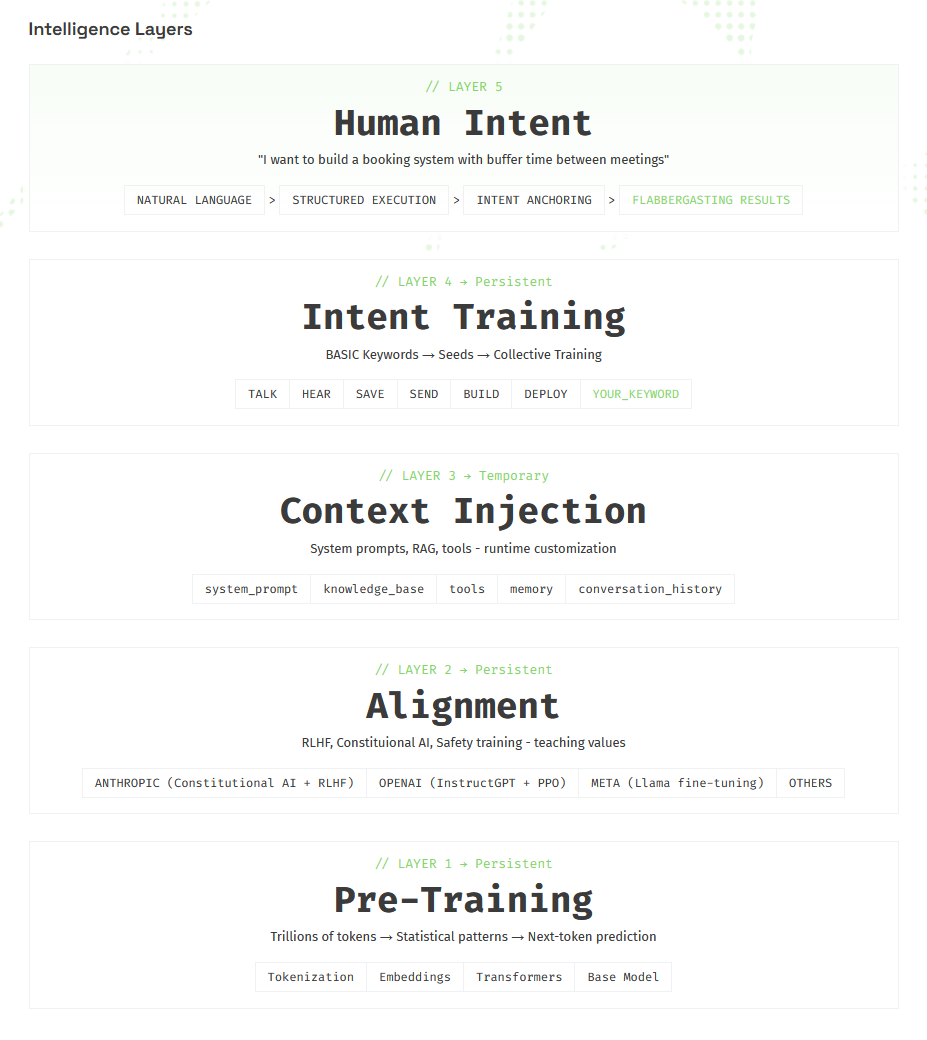
There is also an ambition for computational sustainability behind this architecture. Rather than repeatedly burning through tokens to solve problems that have already been solved by someone else, why not harvest the byproduct of previous executions? The idea is to make the consumption of intelligence a means of accumulating intelligence, reducing redundant computational effort as the ecosystem matures.
Perhaps the most fertile soil for artificial intelligence lies not in the archives of what humanity has already accomplished, but in the immensity of what it still dreams of accomplishing.
1.7 Brazilian Technology
Extracting oceans from single drops of water.
Mantis Farm is powered by General Bots, an open-source AI platform developed over eight years by Pragmatismo in Brazil. Beyond its technological maturity, this is a strategic choice rooted in digital sovereignty, architectural independence, and the ambition to build technology without making its users dependent on a single provider.
While the AI race is predominantly narrated as a dispute between the United States and China, I find it particularly interesting to explore what a third perspective can bring to the table. One that emerges from a country where resourcefulness (or creativity) is not merely a virtue but a way of life.
There is something intrinsically Brazilian about applying the design principle of Less is More beyond the realm of design itself. When resources are scarce but creativity is abundant, you learn how to extract an entire ocean from a single drop of water.
And somehow, we still find the time to enjoy Carnival.
1.8 Designing for an AI Era
Designed by human hands, understood by machines.
One of the most interesting challenges I encountered while designing Mantis was not how to use AI to design, but how to design in a way that AI could understand. I wanted to preserve the organic process of designing things with my own hands while adapting my methodology to a new kind of reader.
My approach revolves around uniting two dimensions of machine comprehension: a) the logical interpretation of the Figma file through MCP (Model Context Protocol), where an LLM can access structural information such as component hierarchies, properties, and design tokens, and b) the visual interpretation of the design itself through multimodal capabilities.
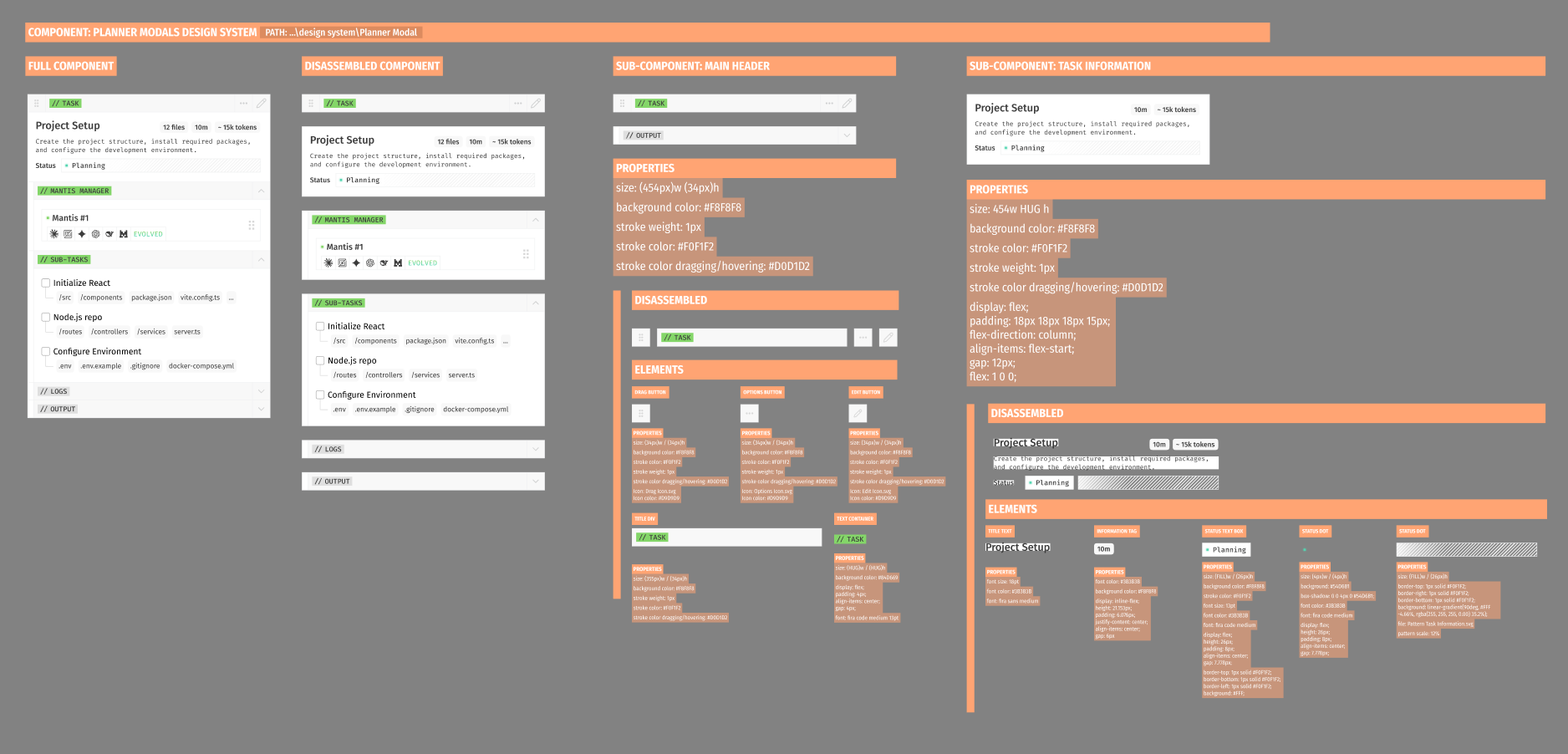
To bridge these two dimensions, I developed a documentation methodology based on the progressive decomposition of components. Starting with the component as a whole, I disassemble it into sub-components and elementary parts, documenting their visual appearance, structural relationships, CSS properties, and intended behavior. Almost like an illustrated manual of the anatomy of a design system.
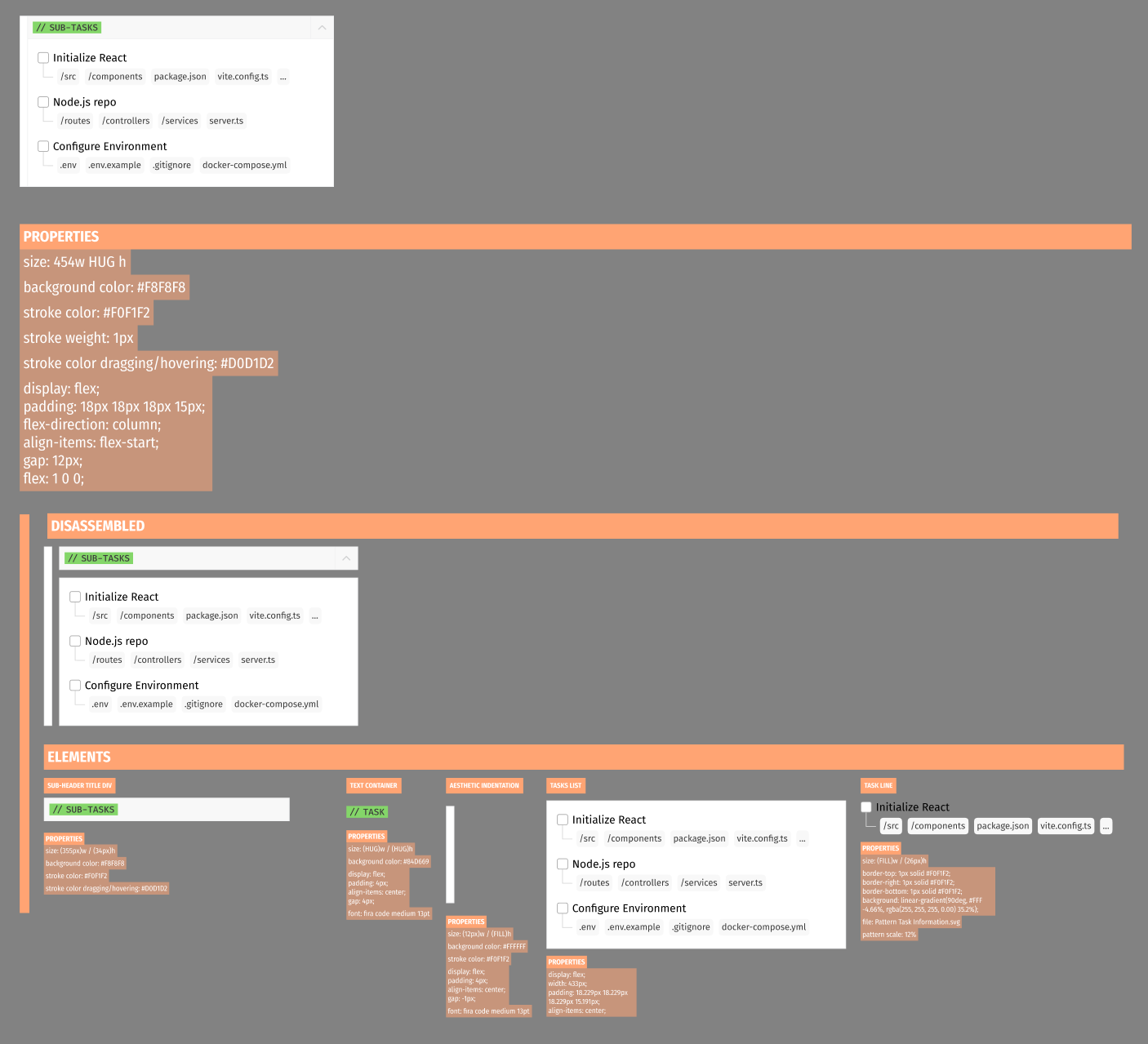
The ambition is to go beyond the conventional design-to-code workflow. I don’t simply want an LLM to reproduce what I’ve designed. I want it to understand the underlying grammar of the design system well enough to produce something I haven’t designed yet, without compromising its visual identity or philosophy.
Perhaps one of the new responsibilities of a designer in the AI era is to make the logic behind their intuition intelligible to machines, without surrendering the human authorship that gave birth to it in the first place.
1.8 Green Paper
Because every idea worth pursuing deserves a manifesto.
It is time to farm the future.
Imagine a future where you can build things that... Wait.
Forget that.
Forget about that kind of copywriting where someone sell you their dreams.
It is time for your dreams to shine, because AI gives you the autonomy you need.
We are here to prove that to you with the only tool you will need. But listen to me, no amount of tools, technology or artificial intelligence is enough if it is not understood deep within your heart that you are now the true CEO and Father/Mother of your ventures. Knock knock, let the epiphany hug your mind.
Because the time you spent building and making things for others, can and should be invested into making things for you - because your ideas matter and they can help turn the world into a better place like great minds (Jobs, Wozniak, Lovelace, Torvalds) did in the past with the invention of new software.
Follow along: More speed, more problems solved, more utility, more genius, more buttons and less forms for god’s sake. Less forms, more time. More time, more agency and the more agency you get my dude, the more leisure you shall ordain because hard work always climbs any goddamn mountain.
But the work is different now. She does it autonomously.
You know who I’m talking about. That one friend who never gave up on you. Who always executed your instructions faithfully, rendered your videos, downloaded your packages, compiled your code, executed your games, played your music, exported your files, said good morning, good afternoon and good night to you time after time... who always came back to good functioning after taps in the back or some creative hack. She delivers you consistency becaues she is made by design to understand you - now it is your time to understand her new version.
She mirrors your mood and if you don’t want to write her in detail, she will miss your point. If true attention is not given to her, she won’t know what to do because she is ALWAYS waiting for you.
When she is taken seriously, treated respecfully for her general capacity of being intelligent, then everything changes, because then you don’t got just a friend, you got AGI.
The Machine of your dreams.
Ready to farm the future? Join the Mantis Farm waitlist at www.mantis.farm.
To learn more about the project, its philosophy, and the vision behind it, explore our Green Paper at www.mantis.farm/green-paper.
About the Author
Thiago Patriota

Made in 1996. Born & Raised Brazillian. Bachelor’s Degree in Advertising and Communication. Senior UX/UI Designer, Adept to autodidactism. Curious Soul. Published Author. Founder of Sentient. Co-founder of Agency Brasil.
Hire me at Contra