



Introduction
Attention, attention. Find yourselves a good spot in the middle of the crowd: rule zero of any rock show has always been to arrive as early as possible so you can get close to the stage, the artist and the sound system.


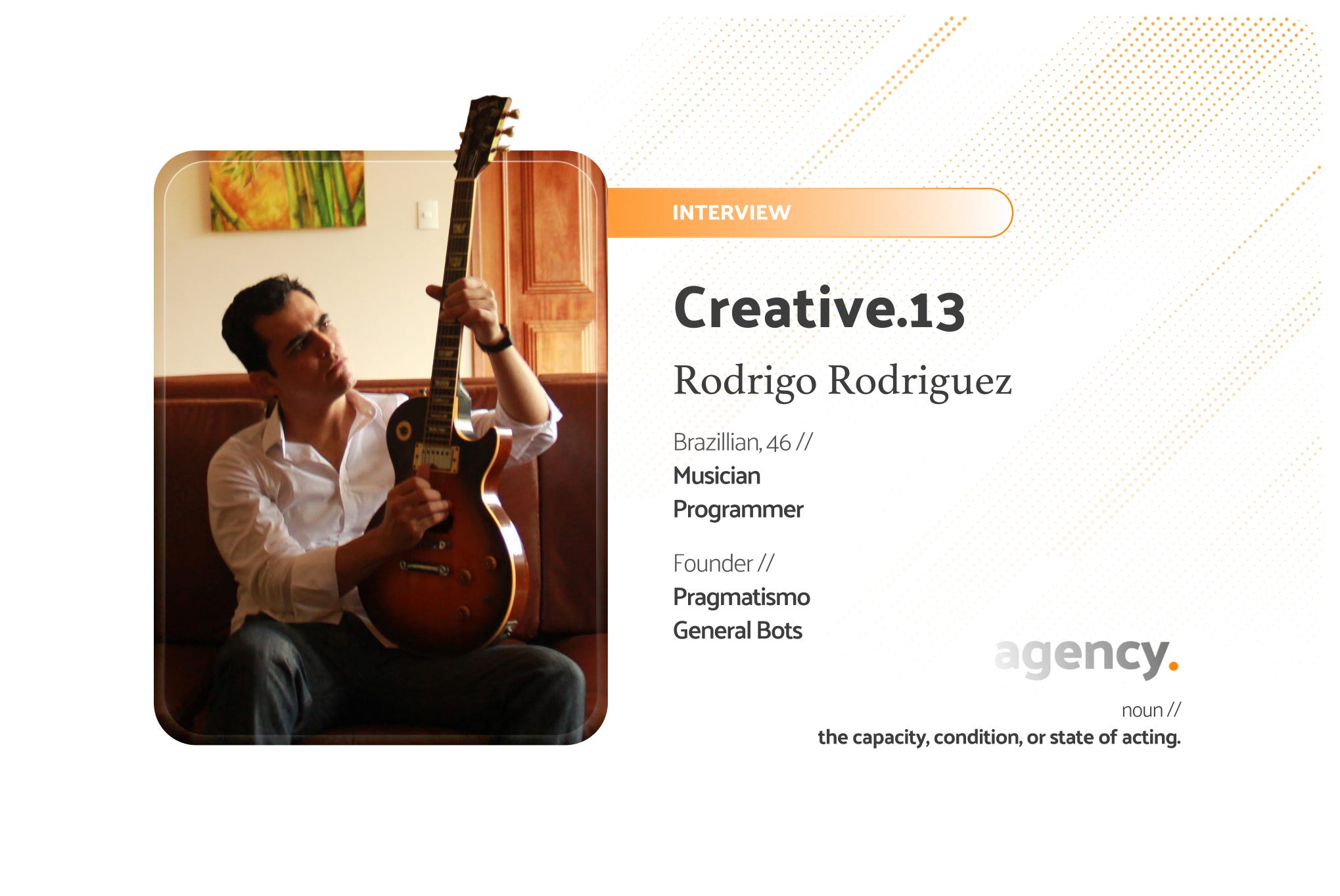
Today’s interviewee came out of the networking from my trip to Rio Innovation Week 2024. I still remember it: I had written a few emails to pitch a project, and he replied with a link to a Code of Conduct and a scolding for having used the word “bacana” (Brazilian slang for “cool”). To him, it’s a racist word. To me, it was the first of many lessons I would still receive from him.
Since then, October 14, 2024, we have kept working together on many projects and talking about life, masculinity, women, politics and, of course, technology. Much of what I know today about the world of programming I learned from Rodrigo, in a conversation, an email or a video call that would naturally turn into a classroom, thanks to the teaching spirit he carries.
He doesn’t like it when I say this, but if anything is written in the stars, Rodrigo is the astrological father the cosmos gave me as a gift! I get ultra protective: when I see someone disrespect him, I attack like a lion with a parrot on its head, because only someone who has never heard his track “Linha do Tempo” would dare make fun of Rodrigo Rodriguez.
The stage is yours, Rod!
Interview
1. Rod, let's start with the fundamentals. You have a psychological thesis about sexuality in the contemporary era that cost me a lot of discomfort and reflection before I could synthesize it. Can you share with our readers what SO-OCD is and how it affects the lives of men and women today?
When I was a kid, my father told me: "Only fags eat Farinha Láctea" (a powdered infant cereal). You can see the origin of homophobia right there. So little by little I identified it as SO-OCD, or TOC-OS in Portuguese, and I discussed it with my psychiatrist at the time. It isn't very well known. Well, I have friends who, if they move more sinuously or speak in a certain delicate way, sort of get a shock on the spot. They still have the OCD. In fact, I believe all of society is sick with this disease in some way. It's a limiting disease. I couldn't move my hips properly. I'm a singer, and I only learned to sing once I understood this. Today I'm healthier than when I was younger. I'm a liberated man. I don't think about being straight, I just am. Obviously, the OCD comes back; it never goes away completely. If you make me very angry, for example by bullying me on the subject, I might end up cursing something, because it's a slow process, and cultural roots still seed us in some way. But the government needs to act by educating people. I always suggest something like Homophobes Anonymous, but with a name that won't scare off sick straight men.
2. Your life story, and especially your corporate career in IT, has been marked by survival in many hostile and abusive contexts. What was it like to observe human behavior in those environments until you arrived at your theory of SO-OCD?
I was a Bill Gates fan, because when you're a macho guy, you end up needing other macho guys to be inspired by (like in a tribe), and BG is interesting in this case because he's macho but physically the weakest of the bunch, so at the time he was an example (today I consider him a terrible example). But he was a billionaire, and I lived in a slave-owning culture that idolized billionaires (as figures of power), so for the egocentric, astronomical ideas of SO-OCD, of being the ultimate male, Bill worked. I saw this in IT environments in Brazil and around the world in general, always dominated by men. When Pragmatismo was founded, the code of conduct was always a guide for us, a page already turned. We always talked about the OCD with all our collaborators, and in general, natural competition became much more fun. But it's very difficult to implement, because the cultural barrier is very strong.
3. Another topic you know closely, both from living through it and from producing material about it, is stalking. How does stalking, especially acoustic stalking, affect a victim's life in ways that often go unnoticed? Imagine you're sleeping in after a long night of work and you're woken up by someone deliberately making noise to wake you. Can that be considered acoustic stalking?
I don’t consider that stalking, the act of making noise at some random hour, as long as it’s within the noise ordinance. If you were sleeping, you can’t ask someone to stop the noise if it’s in the afternoon, for example, or even at night, according to the noise ordinance.
Acoustic stalking has to be feedback, the result of an interaction that repeats itself and characterizes persecution. In other words, a musician at home who is harassed “as the music plays.” For example, imagine listening to a 10-track album, and every time the track changes, you hear someone banging an object, 9 times.
The important thing is to report it quickly and handle it through the justice system with someone who specializes in the subject, because you’ll hardly succeed against narcissists on your own.
4. Now let's talk about you! Where are you from, how old are you, and what languages do you speak? What would you say about Rio de Janeiro to readers who have never had the chance to visit the city?
I'm 46, I speak Portuguese and English. It's a good place, but with many neglected areas, without care from the local government for decades. With Lula re-elected, the fascists have pulled back. So it's becoming a better place to live, with more art and culture; people are speaking up more. The general climate of fear seems to have eased.
5. You're a true believer in self-teaching. Can you share a bit about your academic journey? These days, what does your process of studying, learning and staying informed look like?
Although the Salesian school gave me a good education, my brother helped me much more by teaching me a single computer command, “win,” to get into Windows (which at the time turned me into a Microsoft fanboy). He challenged me to learn the rest on my own, and later gave me some programming magazines. So I kept going on my own, reading books. I always had a lot of trouble reading. I couldn’t finish the books for school, but I would read the C books several times until I learned them. I spent 14 hours a day on the computer, and during the university entrance exam period I couldn’t get into a public university because I didn’t know the subjects. There was a year I attended only 40 days, but I still passed, through make-up exams. On the other hand, in 1995 I wrote a program and brought a PC to the Salesian school’s science fair, and it got an 8 instead of a 10, believe it or not, “For using a computer!”
In other words, the process was a “bump-start,” like a car starting up in the cold. Today I just read the news and go deeper if it relates to some practical action, because it’s become more monotonous. Ever since I realized that learning and revolution are more of the same. The slave-owning environment repeats itself, people exploit others, and engineers dream of creating something revolutionary. That’s very good and natural, but today I believe keeping the machine working in our favor is good, while the relentless pursuit of bloody victories must be stopped. Pointless competition. We should have a tribunal for anything that delays, above all, equal well-being, the cure of diseases and longevity for everyone; the rest is not a priority, at least for now.
So disruption, for me, is slow and silent, but I still believe I can help people, with or without technology, in some way. That’s having a hopeful outlook on life. Because in practice, yes, continuous study and self-improvement that serve to make someone’s life better make total sense. At times, a digital detox is necessary for those who work with machines, even to understand that if someday you need to use the health system, if it’s modern and up to date, that can be an advantage for any citizen. We are dependent on technology, but we can deal with that collectively, not through individual merit. Tech heroes could disappear. That’s perhaps why the academic world was so good for me, at a distance. Ego destroys many good scientists.
6. What were the first years of your corporate career like? When did you realize your affinity for technology and turn it into a profession?
I was somewhat exploited when I started earning some money. I found places where I saw racist scenes and left quickly, others where I tolerated what I shouldn't have... Because when you have SO-OCD, you'll always have a hero to follow, even if he's a bad guy... Because you don't have the self-confidence to say: I am my own engine, period. I can have influences, but the final decision is my own judgment. Maybe that's why the fanboy developed in a servile way toward Big Tech and lived in the Windows world, without knowing Linux, until I worked with some startups of the time, in telecom and banking, where the UNIX environment let me look further. But even then, Bill Gates was always a guide.
7. How many years of career do you have today, which companies did you work for before starting your own business, and what were your roles and responsibilities there?
At 6 or 7 years old I was typing computer programs in BASIC on a TK85, a gift from my father. My brother, 5 years older, understood the programs a little, but I really just typed them WITHOUT understanding absolutely anything. I stayed like that for a year or two, until the computer broke or something. An interesting episode: I had memorized that the RETURN command was the “return from the subroutine.” So, going to a building supply store with my uncle, I looked at a salesman’s green phosphor monitor, and it said RETURN something... Wanting to show off my proficiency, I said: “Ah... RETURN is the return from the subroutine, examining the program.” I remember the salesman looking at me with his jaw dropped, not knowing what to say. But I didn’t even know what it meant.
Later, an uncle of mine bought a computer, which my brother was using, and he taught me to type “win” to get into Windows, and from there I went on alone. My brother then gave me some Visual Basic magazines, and for Christmas I’d ask for books like “C for Dummies.” So with my father and my uncle, I can say those were my first jobs. When I was about 11, my father and I created a factory for reconditioned brake pads. We had a tested prototype. I always wanted to push his auto shop forward, so maybe I had already started as a technology consultant. My uncle sells wooden and plastic household goods, and I always helped him and made myself available for deliveries. On top of that, at 8 years old I started making perfumes with flowers, talcum powder and alcohol, using hundreds of perfume bottles a friend’s mother had, but they didn’t hold their scent well. One customer reported going to a party and not smelling the perfume at all; it got lost somewhere along the way...
So those were business experiences before I even started with computers. At 12 I was also a waiter for one night. Then at 18 I really picked up the newspaper and went looking for a job, and that’s when the song “Não Havia Ninguém” [There Was No One] was written. I found a partner and we formed Software Seguro to sell insurance software. The software was amazing, but we didn’t have a good sales team. Soon after, I joined some software consultancies and startups, until I stayed at IMAGO for a good while, in a very good environment. Many people were trained there who, unfortunately, because of the brain drain, are now outside the country.
Then I left IMAGO at the height of the product vs. project issue I had with the company, and went to prioritize product outside of it, founding Pragmatismo a few months later, without competing with IMAGO, which has become the successful VPN of today.
8. At what point in your life did you realize you wanted to lead and have your own business? And what led to the creation of Pragmatismo and General Bots?
I always wanted to create products, since I was a kid, but it was Othon from IMAGO who identified me as a leader. I had no idea. I was in a comfortable position at IMAGO, and Pragmatismo was an individual response. General Bots went like this: I was working with a Microsoft partner through Pragmatismo, and I went to São Paulo to work on a project with the Microsoft people. It became clear that the Bot Framework was the next step. So we at Pragmatismo, including Jorge Ramos, started serving companies by building chatbots with the Bot Framework, which was very rudimentary at the time. Jorge, with his sharp instinct, realized that instead of repeating the same patterns directly on the Bot Framework, a layer of our own would cut our hours right away. On a call, he told me, very excited: “We can put all of this in a database!” I built it on my own, since Jorge was delivering a custom project and we wanted to keep client data legally separate from what would become General Bots. By the way, Jorge told me something else that led to the creation of Pragmatismo itself: “We can put together a development team!”, while we were prospecting a big project, around 2016.
9. What is Pragmatismo to you?
It's having the responsibility to deliver the truth in the best possible way, with immediate social care.
10. I once exported the General Bots documentation from GitHub and the result was a 2,300-page PDF. Can you explain to our audience what General Bots is? What does it represent to you?
A complete, autonomous artificial intelligence system with cutting-edge features, including a suite of applications, where you own the entire platform, can put everything in a private location and create a version that's yours alone. Imagine having Google Drive or Microsoft 365 on a USB stick and talking to all your data on your own infrastructure, offline or in the cloud. And best of all, with no licensing costs.
11. Now let's talk about music! How many years of musical career do you carry with you, and besides your vocal mastery, which instruments do you play?
34. My grandmother always sang while washing clothes, and my mother while tidying the house. My other grandmother told my mother to put me in music lessons. One of my uncles always sang Bee Gees, the other was addicted to the Beatles and British rock, and through my brother introduced me to Dire Straits. MK [Mark Knopfler] was fundamental to my formation as a musician, while Michael Bolton and Sting were fundamental to my formation as a vocalist.
My father had a trailer bus called Trovão Azul [Blue Thunder]. He took part in the filming of the movie Rock Estrela, driving the bus, so my father took me to a few places involved with music. He had once owned a guitar, and he bought a guitar for me, but he was very sexist and made my mother pay for it, since she had started working. He also played a little acoustic guitar, just the basics, and tried to sing some Roberto Carlos songs. I also remember him pointing at the radio during some guitar solos and saying, "That's music." But it was my brother who taught me my first chords on guitar and keyboards.
12. What technical singing secret could you share with the aspiring musicians who follow us?
Understanding the theory of Charles Darwin, the father of biology, in the sense of understanding that I am a rational animal, and using that in the moment of singing. In other words, I was enslaved by my father’s, let’s say, more fascist culture, because he was in the army and he turned me into a homophobic man with locked hips. But in deep reflection, I understood that his wish, if he purified himself, would be for me to use the fact that he bullied me over the Farinha Láctea to spread the idea of good and heal men. That’s, let’s say, an interpretation of a thought, which helped me see logic in, for example, composing “Checagem”. It’s as if it were my father, healed, speaking. Or me, explaining it to him.
So, being healed, my hips work, and I can sing well because of that. Now, I breathe only through my nose. I learned that in one of the singing lessons I had, to warm the air. And I spend hours just breathing through my nose, standing up and moving my body a little. That creates very good muscle control, besides loosening the jaw. In other words, taking on the role of a singing animal, which like any other emits sounds and emotions through vibration. Visualize it simply, without glamour: singing is muscular expression, air vibrating, bones shaking. Having a biological view is fundamental. Don’t imagine yourself as a pop star, but as a simple soul manifesting itself.
If a macho guy wants to sing, he has to do the high notes really thin, he has to yawn really, really thinly. It might even seem feminine (but it isn’t), and that can keep certain men from singing effectively. It’s basically fear of moving your hips. Often, in an OCD scenario, a man even wants to forget he has glutes.
And in the case of women, I imagine they should free themselves from stereotypes that might in some way deprive them of natural movements or expressions.
It’s singing with your whole body, whatever you feel. And without shame based on oppressive cultures. In other words, it’s not singing for the camera, but finding in yourself a physiological activity: singing without shame, simply because you can, and simply because you have it.
13. Although you're humble about it, you're a great songwriter, Rod. Many musicians can't cross that border between playing and actually creating music. Can you give some advice to artists who haven't yet found that creative voice within themselves, that ability to create instead of just reproduce?
Thank you. It’s hard now, because I still haven’t figured out how I can make an album without AI and have anyone believe it. I think the safe advice would be to sing whatever comes to mind with an instrument you can use for a while to make some noise. Even if it makes no sense at first, because it’s a long road and, pay close attention, it requires a bit of prepaid energy. You only need to spend a few months to get better. If you can keep going back to the drawing board, it becomes a practice and improves naturally.
In any case, in 2026, any album released these days could have AI and nobody would know. That’s a bit discouraging when you listen to something “unreleased.” You’d need to make music in a controlled, closed environment, with no computers, just pen and paper, for a few weeks. If a track comes out of that, then yes!
Now, playing covers is a lot of fun and a practice that helps you develop your own ideas, without AI. Because it’s you there, live, singing, and that practice becomes natural over time.
14. Can you choose and share one of your songs? Tell us a bit about the process of writing and producing it.
“Boas Palavras”, because when I wrote it I was vibrating without swear words. It was when I spent some time... you know, living in Rio, you end up getting polluted again. But this song reminds me that I can speak Portuguese without swearing and in a positive way.
Since this is art, allow me to break the rule and talk about just one more: “Desisto do Mercado”. This song represents a soul in conflict within a slave-owning, payola-driven environment, longing for artistic freedom.
15. We've talked a lot about our relationship with the machine, and we share the idea that one day we'll probably live somewhere peaceful, without the need to operate it. If this question were your chance to write a farewell letter to it, what would you say?
I wouldn't write a letter to a machine. But once, when I was leaving Elefante, on my last day, I recorded a message for Paraná, a friend, saying: "Paraná, it's me, I'm here inside the machine, Paraná, get me out of here." I put it in the task scheduler, and it ran the next day at 2 p.m., with everyone in the office and around the machine having no idea why.
16. Do heroes wear capes, Rod?
Heroes belong to the moment. They become.