


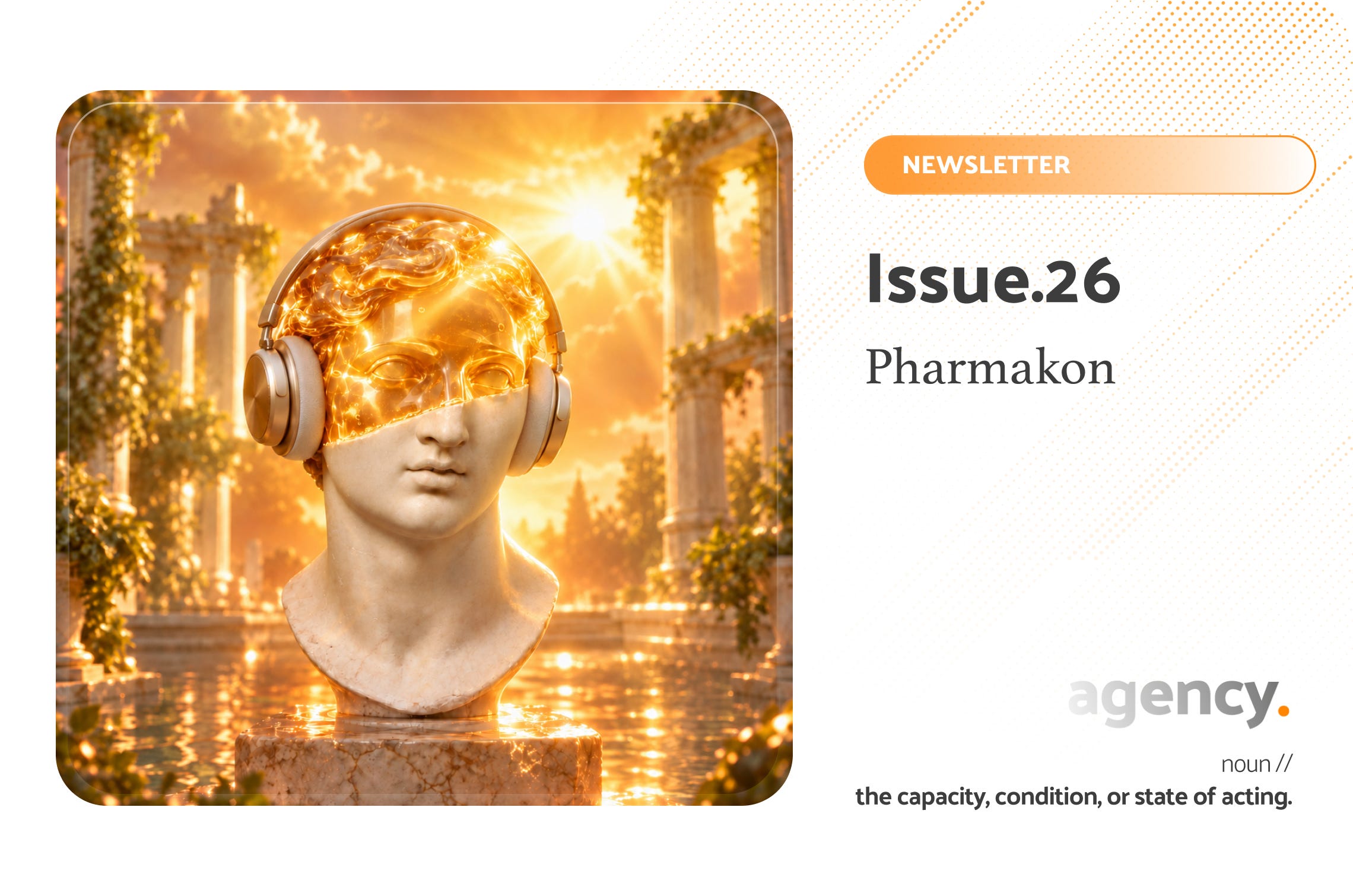
26. Introduction
Hey reader.
I will be straightforward with you.
The theme of this issue is a mind bending paradox.
The grandiosity of this theme is such that it made even Plato hypocritical
Yes, I said Plato.
And hypocritical, not hypercritical.
Thus, be advised before reading - this issue might make you confused for a while.
But a much needed epiphany might land eventually.
Or you will just stay confused… But at least I warned you.
There is something else to consider…
Writing this article will be like a freestyle rap.
I usually research a topic in-depth before bringing it to Agency.
Or at least make sure I integrated the topic properly before writing about it.
But this time I will make an experiment - I will research it as I write the issue.
It’s called documented field research. Mr. Darwin taught it to me.
The last time I was stuck in a greek concept like this one, I was frying eggs in my brain trying to understand ‘akrasia’
Akrasia is a phenomenon. It refers to the problem of how someone can knowingly act against what they believe is best.
If a person judges action A to be better than B, they should prefer A; and if they genuinely prefer A, they should choose it. Yet people sometimes choose B anyway.
Akrasia is the philosophical name for this failure of action (or will) to follow one’s better judgment.
Like when you eat way more than you know you should.
Or like knowing you need to study for a test, but reaching for your phone instead.
You recognize what the better action is, yet still choose against your own judgment. That gap between knowing and doing is akrasia.
Socrates argues that akrasia is not really acting against knowledge, but acting from a mistaken judgment about what is best in the moment.
According to Socrates’ account of akrasia, what seems like weakness of will or moral failure is, ultimately an error of knowledge or judgment.
In other words… it’s plain ignorance.
Because… no one knowingly chooses what they truly understand to be wrong?
Let’s hold the horses here, Socrates.
It’s enticing to think that many of the bizarre things done today by demagogues (a word that curiously resembles the Demogorgons from Stranger Things) and technocrats come from mere ignorance.
But the discussion of good and evil within the human nature is a much deeper theme. Let’s not go there right now.
Among the Greymanes, my dragon-riding people, we believe these men mentioned above are sexually troubled, tormented by intrusive thoughts associated with SO-OCD.
(Don’t dwell on the previous line too much, or eventually, it’ll all just click, and you’ll become illuminated.)
(And if you do become illuminated, don’t shine too brightly. The sunlight bothers the Demogorgons. Good thing they can’t handle a girl named Eleven.)
But enough about Akrasia (ἀκρασία).
I’m starting to lose my Greymane decorum here.
Let’s dive into Pharmakon (φάρμακον)
Believe it or not, it is one of the Greek roots behind words like pharmacy, pharmacology, and pharmaceutical.
You have been going to pharmacies your whole life and never even wondered where the name came from?
Me neither.
There’s more to it though.
The meaning of pharmakon was far broader and more ambiguous than the modern english pharmacy.
It could mean drug, medicine, remedy, poison, or potion.
That ambiguity is important because the word did not originally separate “cure” from “harm”
Unlike a word that can be clearly traced to older Indo-European roots, pharmakon has no universally accepted earlier derivation. Because of that, some linguists have suggested it may come from a pre-Greek language.
Let’s investigate it.
26.1 Written Words as Pharmakon
To write or not to write?
Much attention to the coolest reference I brought above to you, reader.
In Assassin’s Creed Odyssey, which takes place in Ancient Greece during the Peloponnesian War, the player eventually meets Socrates, who talks about writing as a pharmakon.
Below is the script of this dialogue.
Player:
Just remembered a student of yours has been taking notes of your teachings.
*Socrates throws papers in the fire
Player:
What did you do that for?
Socrates:
Nobody asked him to write down my words.
Player:
Even so, why not keep it? Share it with others?
Socrates:
Because of a story I was told as a boy.
Player:
All right, let’s hear it.
Socrates:
The king of Egypt, Thamus, was visited by the god Theuth. Theuth offered the invention of writing to the king and told him it was an elixir of memory and wisdom.
But Thamus disagreed. He believed the people would no longer use their memories, for they would simply read instead.
These written words would not offer true wisdom, but only the appearance of such.
Player:
You don’t want your words written down so others can’t use them to pretend to be smart.
Socrates:
Much like creatures in a painting, the words sit there, unmoving. If you ask them a question, they will preserve a solemn silence. And no matter how many times you ask, they will only ever say the same thing.
They cannot defend their message.
Player:
That’s the part you like. The defense of your words.
Socrates:
All who speak should defend their words if questioned about them.
That is why I choose to speak and not write.
That is why any words of mine that last beyond my final breath will be those that people choose to remember.
Those words will be true wisdom and not an illusion.
And so, this dialogue from a video game explains something about our real world: why Socrates never wrote a single book.
It explains why Socrates never wrote a single book.
We only know his myth because his student Plato wrote it down in the dialogue Phaedrus.
And Plato, by a twist of fate, went on to write extensively, putting words into Socrates’ mouth that the philosopher himself might never have spoken.
Yes, reader. Plato condemned writing… in writing.
And thus, we arrive at the concept of Pharmakon
Because, as Plato argued, when we write down words
Just like I’m doing right here on this Agency newsletter
I’m transferring them from memory to (digital) paper, so that they can live forever in a document, while my mind may eventually forget them.
That’s the paradox and the effect of Pharmakon: An exchange
A change of state.
Words change state: dynamic when spoken by my voice, static when written on paper.
Why should I consider writing if even Socrates himself didn’t? You might ask me, reader…
Well, because I’m Socrates’ bastard baby boy and I do things differently from the heroic dinosaurs of the past.
(Please don’t tell anyone, or they’ll make me drink the hemlock… I’m actually down for it if it’s for the greater good: defending the truth.)
(After all, heroes are always immortalized by artists, like Socrates was by Jacques-Louis David in the painting The Death of Socrates. We already talked about this in a previous issue.)

Let’s not deviate from the main subject.
You should write too reader - not because you should avoid becoming a dinosaur
But because the true meaning of pharmakon, of navigating between cure and poison…
Is to change states. Trying new things. Being new versions of yourself.
And you can only do that by writing down how you think today and what troubles your feelings right now.
So that when tomorrow comes, you look back into what a previous version of yourself had to say, what you were feeling.
Socrates was right about the fact that written words can’t be defended.
They can become false, outdated, useless… They can even become legal evidence that puts you in trouble.
They can become a divorce paper you regret
As much as they can become a divorce paper you celebrate.
But in some cases, they can be the only pharmakon for your problems.
After all, nobody would ever refuse a supreme pill of universal cure.
And there is no amount of prescription drugs that can help you change the state of sick or healthy in many non biological aspects of life
And if changing states is the true pharmakon…
Then writing is one of the oldest ways to take it.
26.2 Remedy as Pharmakon
To drink or not to drink?
The Algerian-born philosopher Jacques Derrida wrote extensively about all of this in his essay “Plato’s Pharmacy,” where he connects the ambiguous concept of pharmakon to a related word: pharmakos.
A pharmakos (plural: pharmakoi) is a human scapegoat in ancient Greek religion. During the Athenian festival of the Thargelia, people from the margins of the city were chosen, ritually struck, and driven out to purify the community.
The scapegoat is fascinating because it is both inside and outside the city. It must belong to the community to carry its impurity, and then it is expelled. It is evil (cast out) and remedy (purifies) at once.
Reader, think about this for a second. To this day, every remedy is a pharmakon. You take a painkiller to expel the pain, but it can bring its own poison with it, like nausea or dizziness. The cure and the harm come in the same capsule.
And here is the darkest twist. Socrates himself became a pharmakos. Athens accused him of poisoning the minds of the youth and expelled him the only way you can expel someone permanently: by making him drink a pharmakon. The hemlock. The city cast out its own medicine, a man we still study to this day, believing he was poison.
One of the founding ideas of modern pharmacology came in the 16th century from a Swiss physician with the most bombastic name: Philippus Aureolus Theophrastus Bombastus von Hohenheim.
A.K.A, Daddy Paracelsus
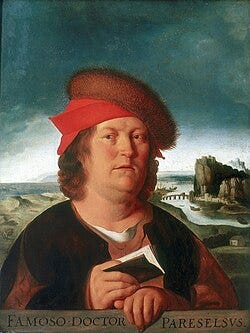
Nowadays people call him a mere alchemist but he paved most of the way to the medicine box you have in your home today.
He argued that everything is poison and nothing is without poison, and that only the dose separates the two.
So no substance is a cure or a poison by nature. Every substance changes state depending on the quantity, the timing, and the body receiving it. Today, pharmacologists measure this with the therapeutic index: the distance between the dose that heals and the dose that harms.
I would also add a “psychosomatic index” to that, because mind and body are deeply intertwined. It is also why placebo medicine plays such an important role in pharmacological research.
But so far we have only talked about chemistry and pharmacy.
Pharmakon goes far beyond that.
Because you can apply pharmakon to many different things in life right away - it’s just a matter of changing states, remember?
Let’s try and make a list:
If there is someone that oppresses you, you change state by establishing boundaries.
If you are used to telling lies and find yourself in a life of appearances, you can change states by telling the truth.
If you find yourself with someone you don’t love as a partner, you can change states by kicking his/her ass out of your life.
If you find yourself in a life you hate, you can change its state to a life you love by changing… many different states!
If you are not used to changing states, you can start changing that very state in the most simple things, like changing the brand of your coffee.
If you are not happy with your work, you change states by quitting or sending resumes to other companies.
If you are not happy with your country, you change states by immigrating.
If you are a religious person that practices your dogma with loyalty but still find yourself in a miserable life, you change states by exploring new religions and dogmas.
If you think that you are a weak person and that people take advantage of you, you change states by getting stronger: by either lifting books or weights in the gym.
If someone in your family keeps hurting you, you change states by calling it out.
See how the concept of pharmakon can be applied in many different things?
The cure is in the process of changing state, not the effect you get after “taking the pill”.
About the Author
Thiago Patriota

Unofficial Special Scientific Advisor and Spartan to the President of the Federative Republic of Brazil