


27. Introduction
Ave, Agency reader! Nosce te ipsum.
I started the draft for this issue and its infographic over two years ago. I finally managed to finish it.
This is the first part of a series in which I will bring forth the anatomy of different empires in the history of humanity.
My goal when I first drafted it was to make a “snack-sized” study of the biggest empires that ever existed, so that studying them would become interesting again for all ages, especially kids.
The idea came from the infographic I made for Issue 24, Boiling Red Cobalt. I thought to myself: “Hey, if Agency is going to produce data sheets with such precious data, why not make one that is more visual and more fun to study?”
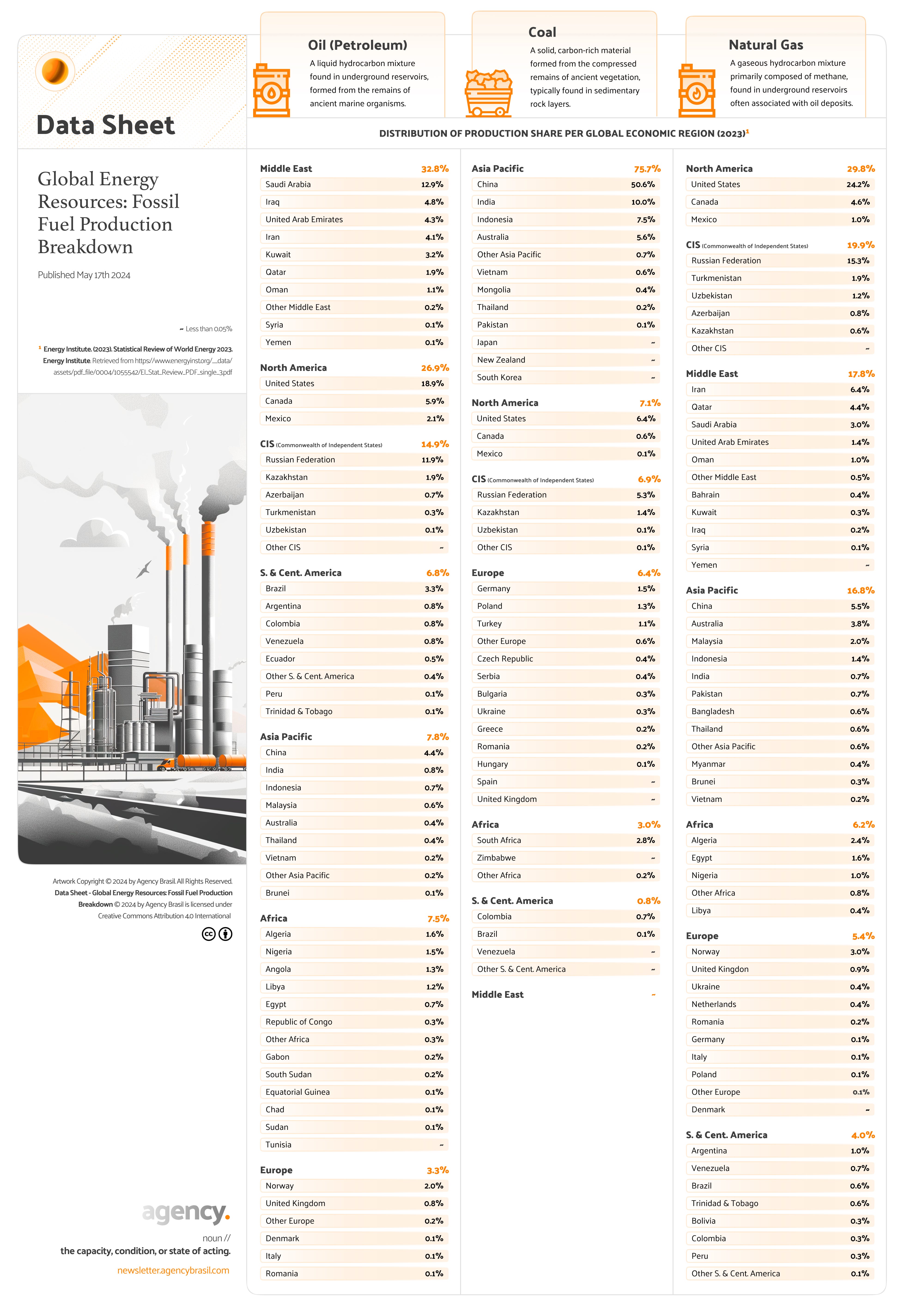
You can download the full infographic of this edition and check the entire study below.

This one is probably the most humanistic article I have written so far.
Now, back to Rome - because it wasn’t built in a day.
I’m not a historian like Yuval Noah Harari (author of Sapiens), but I have always championed the importance of understanding history in order to understand the present.
In psychology, there is a concept called the “primacy effect”: what comes first tends to shape how we perceive everything that follows.
It’s like the popular saying “the apple doesn’t fall far from the tree”: the characteristics of something are often closely tied to its origin.
And so, studying history and understanding our past as a society is fundamental to better understanding the present and better theorizing about the future.
In fact, if we don’t take the time to study what has already happened, society will keep repeating the same mistakes over and over again.
Over and over and over and over again.
Why not break the cycle, since every cycle is meant to be… broken?
Among the different Western and Eastern scriptures I like to read every now and then, there is one passage I have never managed to forget. It is from the Bible, and it goes like this:
Then said he unto them, Therefore every scribe which is instructed unto the kingdom of heaven is like unto a man that is an householder, which bringeth forth out of his treasure things new and old.
Matthew 13:52
If you are a householder, in other words the leader or manager of a family, it is your responsibility to keep a treasure chest with relics both old and new. You can’t have antiquity without history.
And so, let’s dive into this edition about the Roman Empire, where I will explore the key points of one of the most influential and long-lasting empires in history, with a profound impact on the development of Western civilization.
The Anatomy of an Empire
A Mosaic of Roman Civilization
For the “Empire Anatomy” data sheet, I decided to highlight 10 key categories of Roman civilization, from politics and law to food, medicine and family life, each grounded in scholarly references and cited in our own referencing style.
The goal was to capture both the macro and micro aspects of the civilization, from its customs to its state, so we can remember how people lived in the past and rediscover new ways of living in the present.
Merging the old with the new is a Metamodernist approach that ensures we neither idealise the past nor dismiss it, but that’s a subject for another issue.
You can download the full infographic below as a PNG or PDF, or read it section by section. Your choice!
Make sure you wait for it to load!
27.0 Roman Empire at a Glance
Five centuries of empire, and two of its finest.
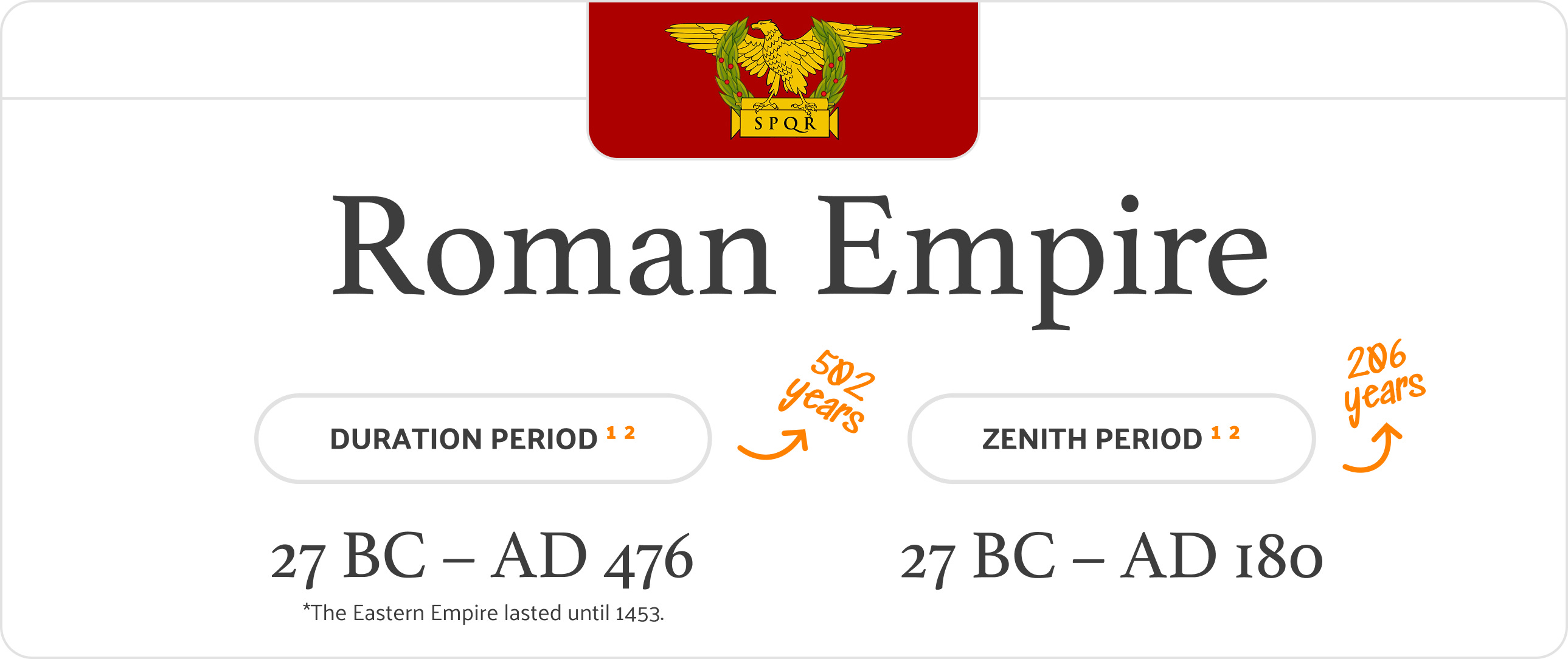
Duration: 27 BC – AD 476 (502 years). The Eastern Empire lasted until 1453.
Zenith: 27 BC – AD 180 (206 years), the Pax Romana
27.1 Political Regime
Imperial Monarchy
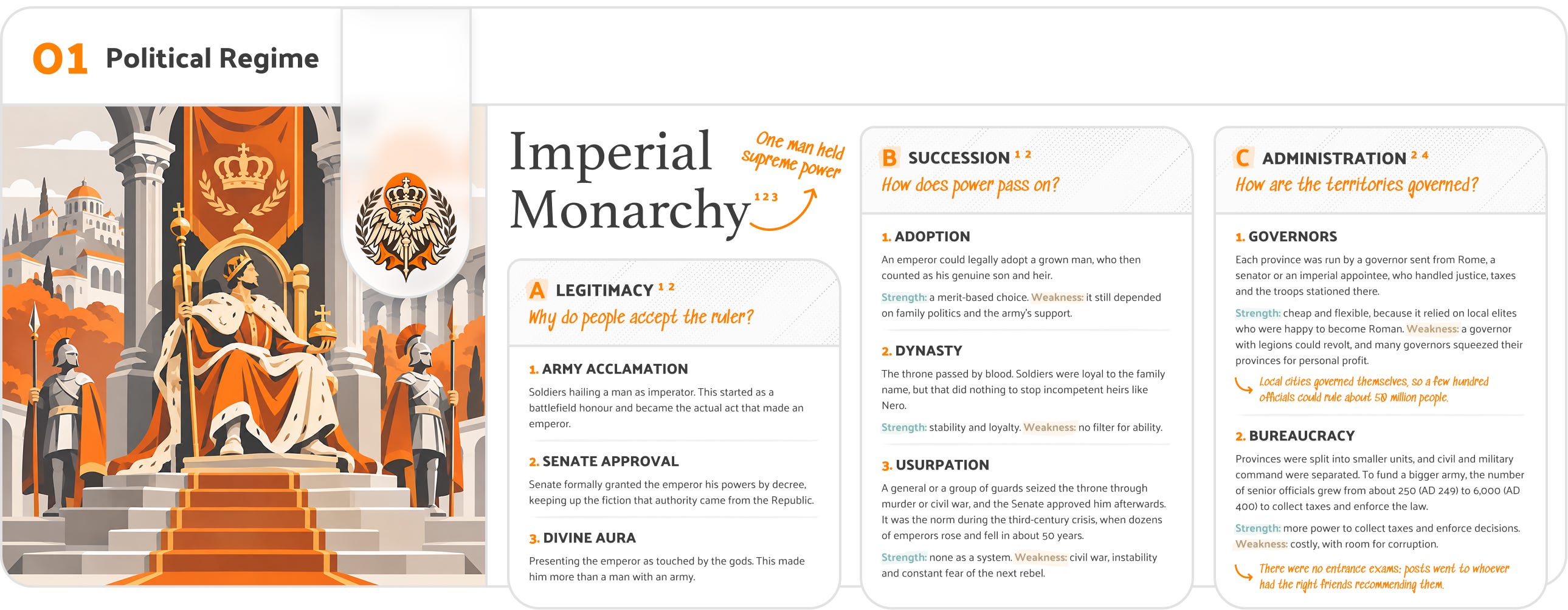
A · Legitimacy: Why did people accept the ruler?
Army Acclamation. Soldiers hailed a man as imperator. The title started as a battlefield honour and became the act that actually made an emperor.
Senate Approval. The Senate formally granted the emperor his powers by decree, keeping up the fiction that authority came from the Republic.
Divine Aura. Emperors were presented as touched by the gods, which made each one more than a man with an army.
B · Succession: How did power pass on?
Adoption. An emperor could legally adopt a grown man, who then counted as his genuine son and heir.
Strength: a merit-based choice.
Weakness: it still depended on family politics and the army’s support.
Dynasty. The throne passed by blood. Soldiers were loyal to the family name, but that did nothing to stop incompetent heirs like Nero.
Strength: stability and loyalty.
Weakness: no filter for ability.
Usurpation. A general or a group of guards seized the throne through murder or civil war, and the Senate approved him afterwards. It was the norm during the third-century crisis, when dozens of emperors rose and fell in about 50 years.
Strength: none as a system.
Weakness: civil war, instability and constant fear of the next rebel.
C · Administration: How were the territories governed?
Governors. Each province was run by a governor sent from Rome, either a senator or an imperial appointee, who handled justice, taxes and the troops stationed there.
Strength: cheap and flexible, because it relied on local elites who were happy to become Roman.
Weakness: a governor with legions could revolt, and many squeezed their provinces for personal profit.
Local cities governed themselves, so a few hundred officials could rule about 50 million people.
Bureaucracy. Provinces were split into smaller units, and civil and military command were separated. To fund a bigger army, the number of senior officials grew from about 250 (AD 249) to 6,000 (AD 400) to collect taxes and enforce the law.
Strength: more power to collect taxes and enforce decisions.
Weakness: costly, with room for corruption.
There were no entrance exams: posts went to whoever had the right friends recommending them.
27.2 Law & Punishment
Unequal Justice
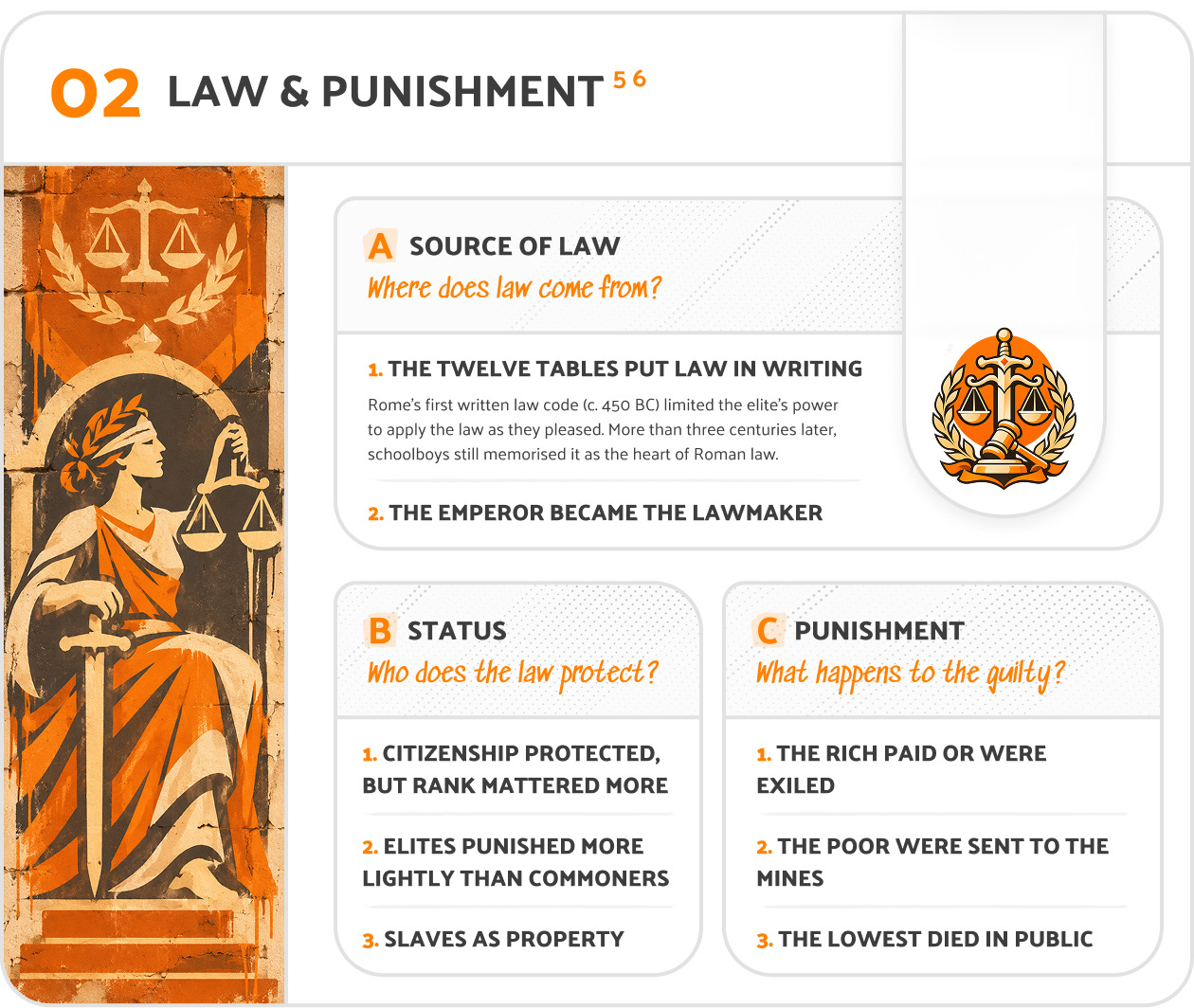
A · Source of Law: Where did law come from?
The Twelve Tables Put Law in Writing. Rome’s first written law code (c. 450 BC) limited the elite’s power to apply the law as they pleased. More than three centuries later, schoolboys still memorised it as the heart of Roman law.
The Emperor Became the Lawmaker. Senate decrees, imperial orders and replies to petitions all expressed the emperor’s will, while jurists interpreted the law.
Rome had no police force in the modern sense.
B · Status: Who did the law protect?
Citizenship Protected, but Rank Mattered More. Being a Roman citizen shielded people from the harshest penalties. Over time, rank came to matter more than citizenship, and by AD 212 almost every free person was a citizen.
Elites Punished More Lightly Than Commoners. From the 2nd century, the law split free people into honestiores (elites) and humiliores (commoners), each with its own scale of penalties.
Slaves as Property. Slaves were legally property, open to any use or abuse by their owners, including torture and summary execution.
C · Punishment: What happened to the guilty?
The Rich Paid or Were Exiled. For the elite, execution was rare. The usual penalties were exile, expulsion from the Senate or local council, and fines.
The Poor Were Sent to the Mines. Commoners could be condemned to hard labour in the mines for life, or to work on public projects.
The Lowest Died in Public. The harshest penalties, reserved for the lowest ranks, were exposure to wild beasts, crucifixion and burning alive.
27.3 Architecture
Built to Last
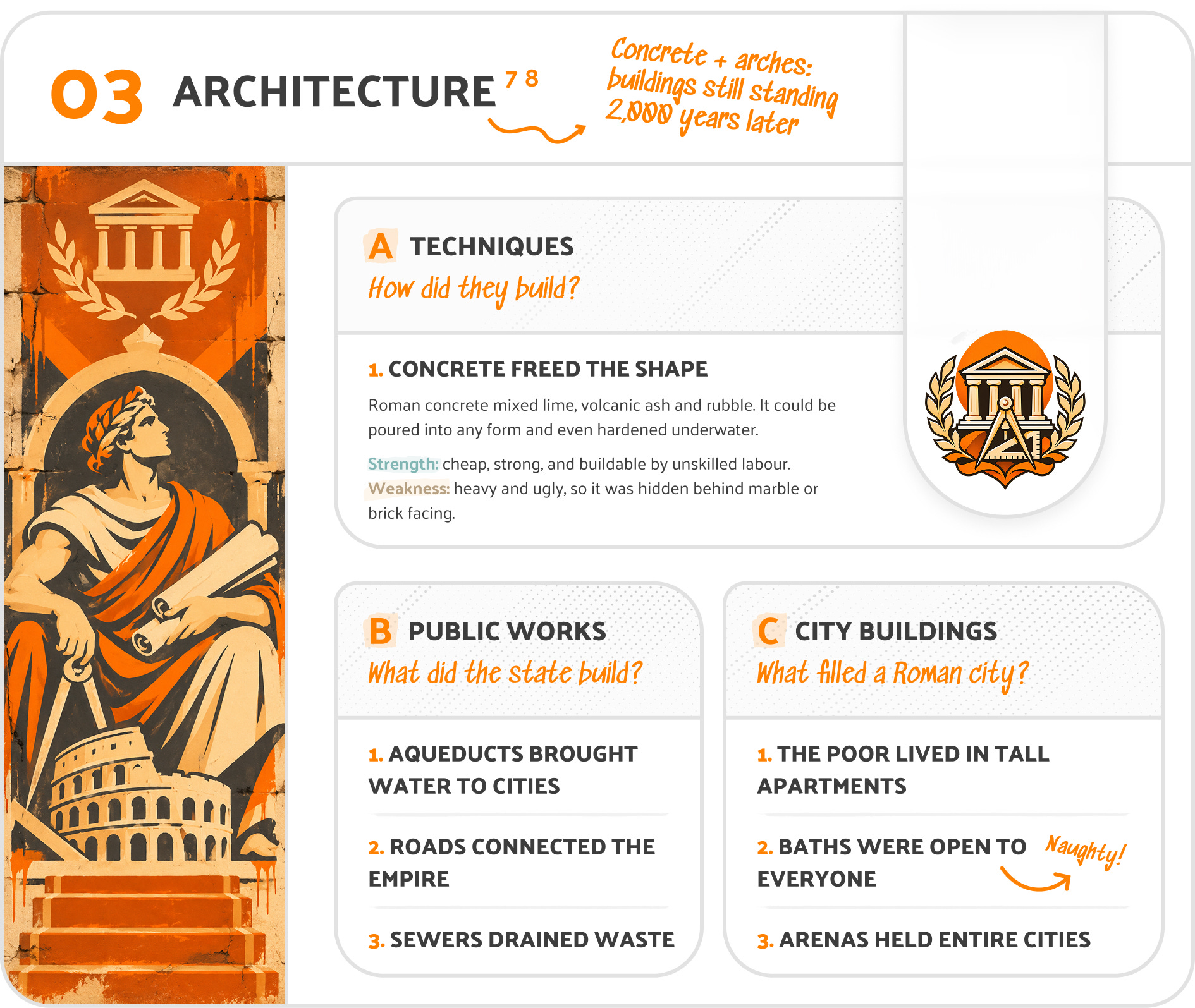
A · Techniques: How did they build?
Concrete Freed the Shape. Roman concrete mixed lime, volcanic ash and rubble. It could be poured into any form and even hardened underwater.
Strength: cheap, strong, and buildable by unskilled labour.
Weakness: heavy and ugly, so it was hidden behind marble or brick facing.
B · Public Works: What did the state build?
Aqueducts Brought Water to Cities. Channels on a gentle slope carried water over long distances to feed fountains, baths and homes.
Roads Connected the Empire. Paved roads linked the provinces to Rome, moving armies, officials and goods.
Sewers Drained Waste. Underground drains fed into main sewers like Rome’s Cloaca Maxima, which carried the city’s waste into the Tiber.
C · City Buildings: What filled a Roman city?
The Poor Lived in Tall Apartments. Most city dwellers rented rooms in multi-storey apartment blocks.
Baths Were Open to Everyone. Public baths, with rooms of graded temperature, were part of daily life for all classes.
Arenas Held Entire Cities. Amphitheatres like the Colosseum held tens of thousands of spectators.
27.4 Economy & Money
An Empire of Farmers
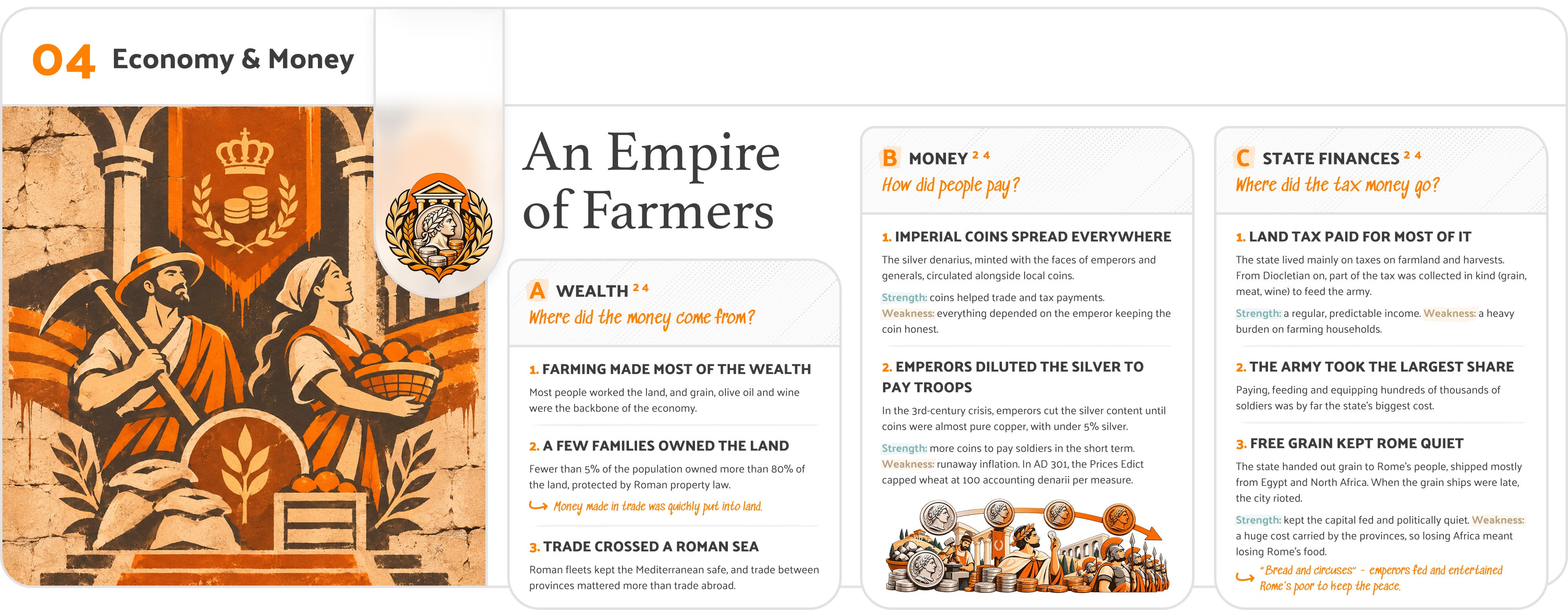
A · Wealth: Where did the money come from?
Farming Made Most of the Wealth. Most people worked the land, and grain, olive oil and wine were the backbone of the economy.
A Few Families Owned the Land. Fewer than 5% of the population owned more than 80% of the land, protected by Roman property law.
Money made in trade was quickly put into land.
Trade Crossed a Roman Sea. Roman fleets kept the Mediterranean safe, and trade between provinces mattered more than trade abroad.
B · Money: How did people pay?
Imperial Coins Spread Everywhere. The silver denarius, minted with the faces of emperors and generals, circulated alongside local coins.
Strength: coins helped trade and tax payments.
Weakness: everything depended on the emperor keeping the coin honest.
Emperors Diluted the Silver to Pay Troops. In the 3rd-century crisis, emperors cut the silver content until coins were almost pure copper, with under 5% silver.
Strength: more coins to pay soldiers in the short term.
Weakness: runaway inflation. By AD 301, wheat once worth half a denarius was capped at 100.
C · State Finances: Where did the tax money go?
Land Tax Paid for Most of It. The state lived mainly on taxes on farmland and harvests. From Diocletian on, part of the tax was collected in kind (grain, meat, wine) to feed the army.
Strength: a regular, predictable income.
Weakness: a heavy burden on farming households.
The Army Took the Largest Share. Paying, feeding and equipping hundreds of thousands of soldiers was by far the state’s biggest cost.
Free Grain Kept Rome Quiet. The state handed out grain to Rome’s people, shipped mostly from Egypt and North Africa. When the grain ships were late, the city rioted.
Strength: kept the capital fed and politically quiet.
Weakness: a huge cost carried by the provinces, so losing Africa meant losing Rome’s food.
“Bread and circuses”: emperors fed and entertained Rome’s poor to keep the peace.
27.5 Technology
Engineers, Not Inventors
A · Power & Machines: What did the work besides muscle?
Water Wheels Ground the Grain. Rivers and aqueducts turned wheels that drove millstones. At Barbegal, in Gaul, 16 wheels in two rows of eight formed an ancient flour factory.
Treadwheel Cranes Lifted the Stone. Workers walking inside giant wheels powered cranes that raised blocks weighing several tonnes.
Pumps and Screws Moved Water. Force pumps fought fires, and Archimedes’ screws drained water from mines and lifted it into fields.
Rome had a steam toy, not a steam engine: the metalwork didn’t exist yet.
27.6 Food & Drink
Bread, Oil & Wine
A · The Staples: What did everyone eat and drink?
Grain Was the Main Meal. Wheat eaten as porridge (puls) or bread made up most of a Roman’s daily calories.
Olive Oil Went Into Everything. Oil was a staple for cooking and hygiene: Romans rubbed it on their skin after bathing.
At the baths, Romans scraped off grime and sweat with a curved metal strigil, then rubbed on scented oils.Wine Was Drunk Watered Down. Romans mixed wine with water to soften its effect, a habit shared across the Greek and Roman world. Drinking it undiluted was considered barbaric.
Strength: safer than plain water and part of daily life for all classes.
Weakness: cheap wine was often sour, and the poor drank posca, vinegar mixed with water.
27.7 Medicine
Good Surgeons, Wrong Theory
A · Practice: How did they treat patients?
Surgeons Used Bronze and Iron Tools. Scalpels, forceps and probes were found in the House of the Surgeon in Pompeii, and their quality wasn’t surpassed until modern times.
Herbs Were the Main Drugs. Dioscorides gathered almost 600 remedies, mostly from plants.
Strength: some remedies really worked, such as poppy for pain.
Weakness: many were useless or toxic.
Wounds Were Washed With Wine and Vinegar. Without knowing why, Romans cleaned wounds with wine and vinegar, which helped prevent infection.
Every legionary fort had its own hospital, the valetudinarium.
27.8 Sex & Marriage
Marriage as Alliance
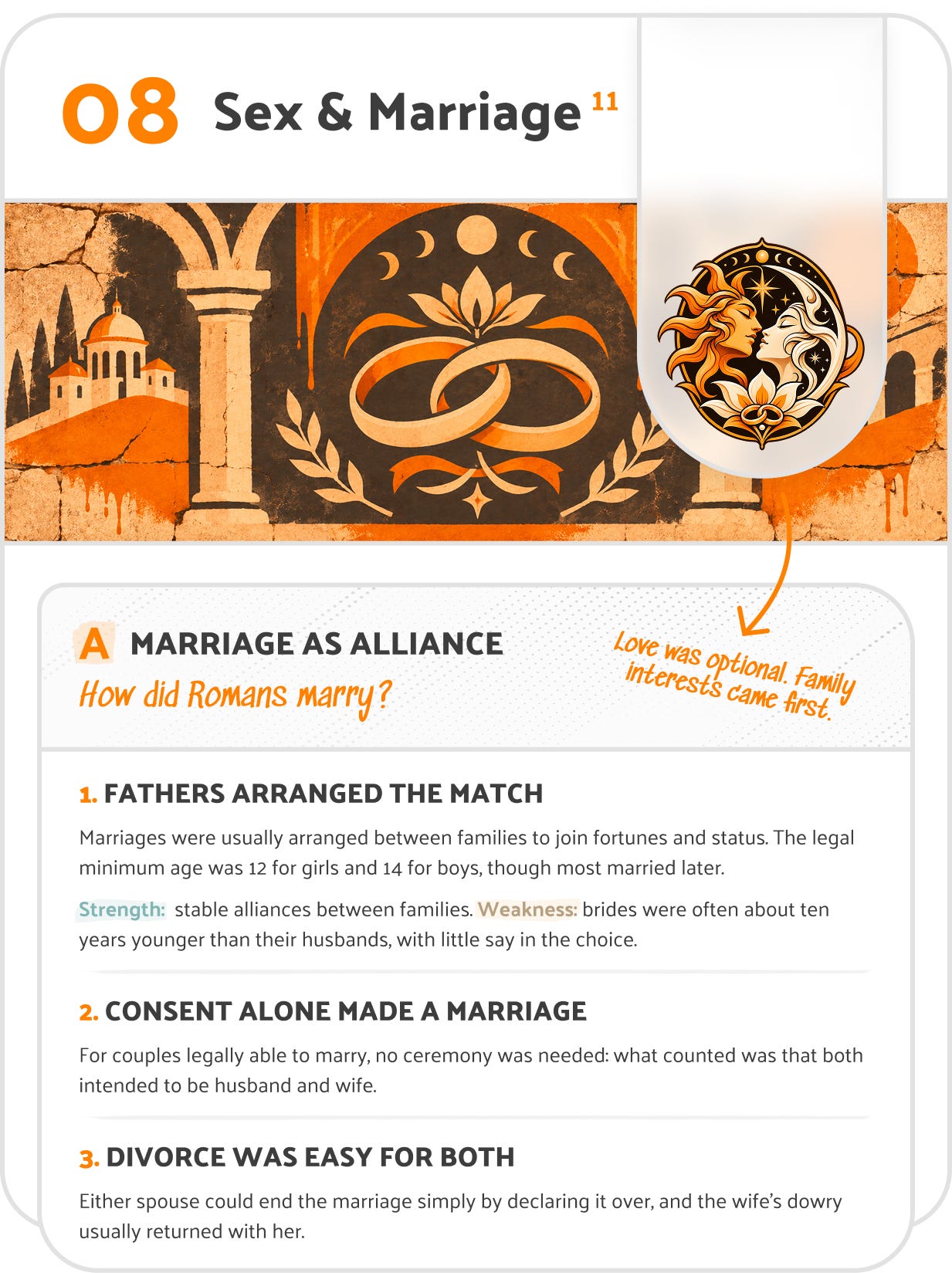
A · Marriage as Alliance: How did Romans marry?
Love was optional. Family interests came first.
Fathers Arranged the Match. Marriages were usually arranged between families to join fortunes and status. The legal minimum age was 12 for girls and 14 for boys, though most married later.
Strength: stable alliances between families.
Weakness: brides were often about ten years younger than their husbands, with little say in the choice.
Consent Alone Made a Marriage. For couples legally able to marry, no ceremony was needed: what counted was that both intended to be husband and wife.
Divorce Was Easy for Both. Either spouse could end the marriage simply by declaring it over, and the wife’s dowry usually returned with her.
27.9 Contraception & Birth
A Dangerous Beginning
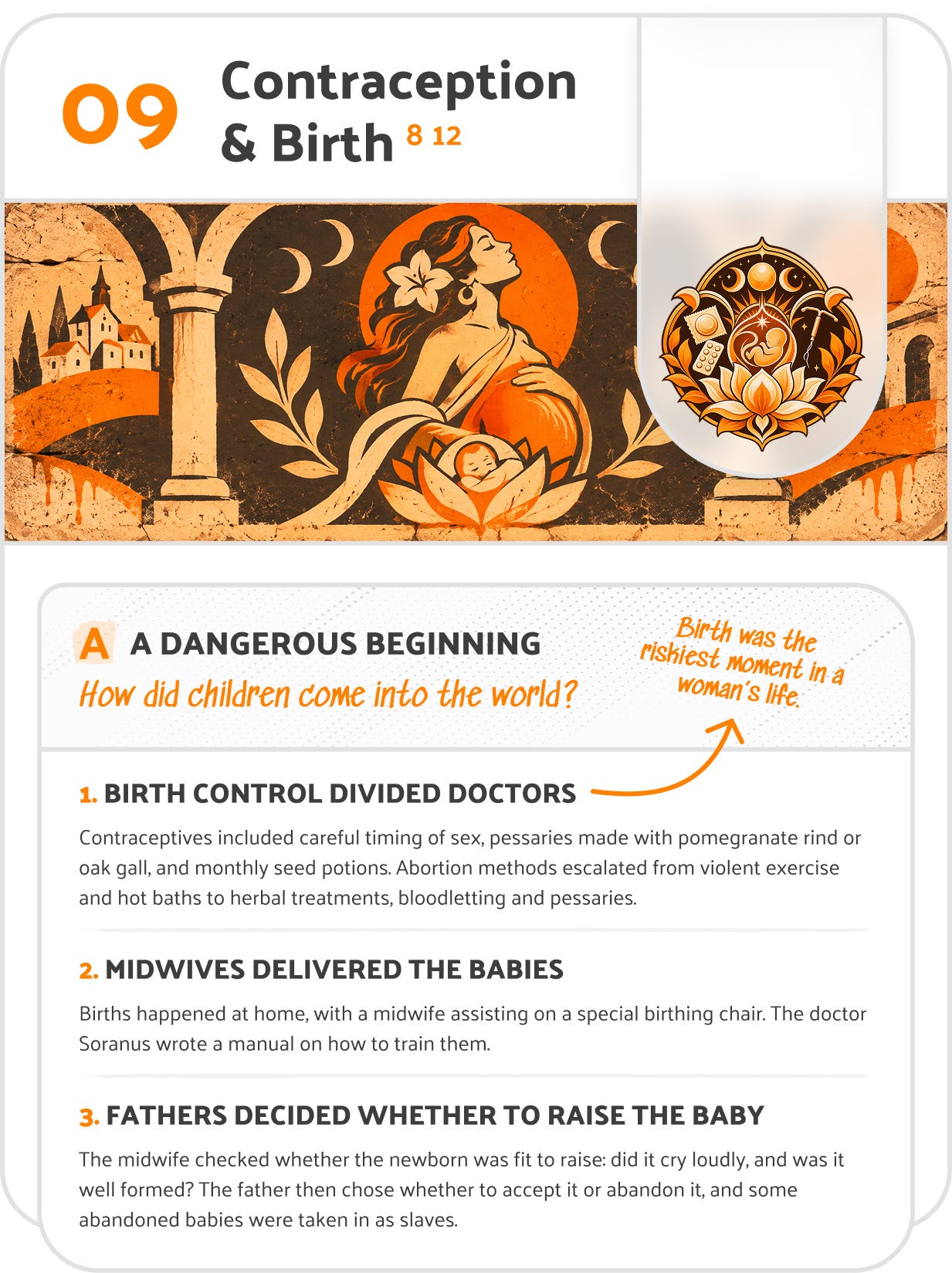
A · Birth: How did children come into the world?
Birth was the riskiest moment in a woman’s life.
Birth Control Divided Doctors. Contraceptives included careful timing of sex, pessaries made with pomegranate rind or oak gall, and monthly seed potions. Abortion methods escalated from violent exercise and hot baths to herbal treatments, bloodletting and pessaries.
Midwives Delivered the Babies. Births happened at home, with a midwife assisting on a special birthing chair. The doctor Soranus wrote a manual on how to train them.
Fathers Decided Whether to Raise the Baby. The midwife checked whether the newborn was fit to raise: did it cry loudly, and was it well formed? The father then chose whether to accept it or abandon it, and some abandoned babies were taken in as slaves.
27.10 Childhood & School
Learning by the Cane
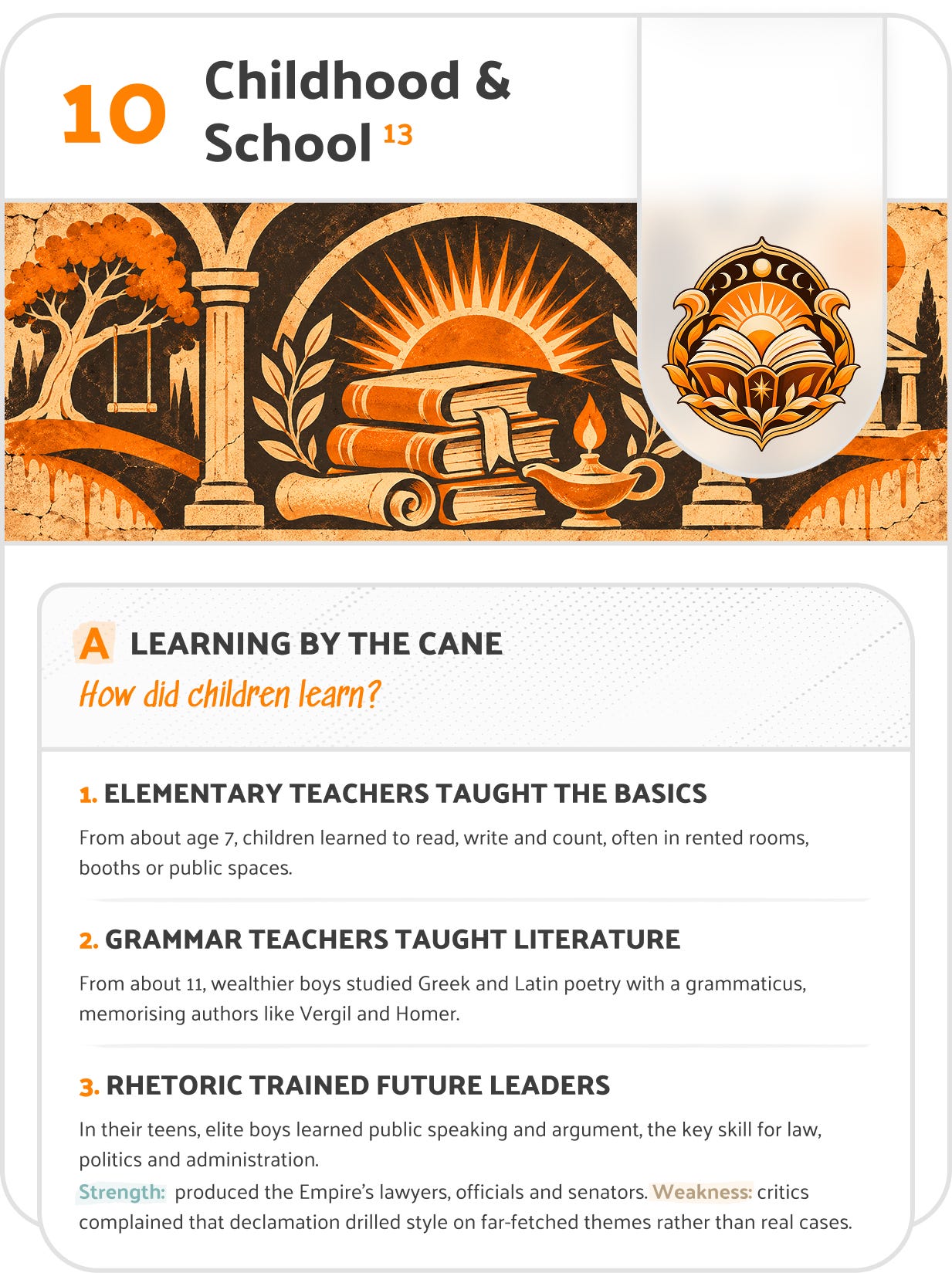
A · Education: How did children learn?
Elementary Teachers Taught the Basics. From about age 7, children learned to read, write and count, often in rented rooms, booths or public spaces.
Grammar Teachers Taught Literature. From about 11, wealthier boys studied Greek and Latin poetry with a grammaticus, memorising authors like Vergil and Homer.
Rhetoric Trained Future Leaders. In their teens, elite boys learned public speaking and argument, the key skill for law, politics and administration.
Strength: produced the Empire’s lawyers, officials and senators.
Weakness: critics complained that declamation drilled style on far-fetched themes rather than real cases.
27.11 References & Credits
¹ Captivating History (2023a). Imperial Rome. 01 (ch. 3, 4, 6, 8, 9)
² Captivating History (2023b). Roman Empire: Imperial Rome and Pax Romana. 01, 04 (Part 2: intro, ch. 1, 2, 3, 5, 6)
³ Dominik, W. J., Garthwaite, J. & Roche, P. A. (Eds.) (2009). Writing Politics in Imperial Rome. Brill. 01 (ch. 1–2)
⁴ Heather, P. (2006). The Fall of the Roman Empire. Pan Books. 01, 04 (ch. 1, 2, 3, 6)
⁵ Garnsey, P. (1970). Social Status and Legal Privilege in the Roman Empire. Clarendon. 02 (ch. 4, 5, 11)
⁶ Riggsby, A. M. (2010). Roman Law and the Legal World of the Romans. CUP. 02 (ch. 3, 7, 9, 10)
⁷ Adam, J.-P. (1999). Roman Building: Materials and Techniques. Routledge. 03 (ch. 2, 5, 6, 10, 11)
⁸ Jackson, R. (1988). Doctors and Diseases in the Roman Empire. British Museum. 03, 06, 07, 09 (ch. 2–5)
⁹ Oleson, J. P. (Ed.) (2008). Oxford Handbook of Engineering and Technology in the Classical World. OUP. 05 (ch. 6, 10, 13, 32)
¹⁰ Dalby, A. (2003). Food in the Ancient World from A to Z. Routledge. 06 (s.v. Grain, Olive oil, Puls, Posca, Wine, Wine-mixing)
¹¹ Treggiari, S. (1991). Roman Marriage. Clarendon. 08 (ch. 2–4, 10, 12–13)
¹² Flemming, R. (2021). “Fertility control in ancient Rome.” Women’s History Review 30(6). 09 (pp. 900–903)
¹³ Bonner, S. F. (2012). Education in Ancient Rome. Routledge. (First published 1977 by Methuen.) 10 (ch. X, XI, XVI–XXI)
Data Sheet – The Anatomy of an Empire: A Mosaic of Roman Civilization © 2026 by Agency Brasil is licensed under Creative Commons Attribution 4.0 International. Artworks are excluded from this license. © 2026 Agency Brasil, All Rights Reserved. The complete data sheet may be freely shared in its original, unaltered form, with credit to Agency Brasil.
agency. noun // the capacity, condition, or state of acting.
www.agencybrasil.com
About the Author
Thiago Patriota

Made in 1996. Born & Raised Brazilian. Bachelor’s Degree in Advertising and Communication. Self-taught by nature. Curious Soul. Published Author. Founder of Sentient. Mind behind Agency.
That’s me in a nutshell, but you can learn more about Agency at www.agencybrasil.com