


Introduction
Did you know that Agency’s most read article is the first edition of Quote about Steve Jobs?

Everyone still talks about him and buys the brand he invented. Almost no one understands what he really did to society.
He cursed all of us with at least a tiny portion of ADHD.
But he also saved our lives.
Through the eyes of a true designer and the heart of a really creative human, he made machines acessible to everyone.
We just never imagined we would end up so dependent on screens, or so surrounded by them, in nearly every aspect of life.
Or that, on those screens, we would overdose on information, attention-grabbing algorithms, and meme videos that help us pass the time but waste it just as easily when left unchecked.
In an age when computers meant IBM’s room-sized industrial machines, he imagined them as smaller, personal, colorful, friendly, and desirable objects.
“How did he save our lives?” You might wonder.
Through his advertising genius - He made computers cool, and that changed everything.
If you ever read 1984 by George Orwell, you will get what I’m talking about.
Because the launch of Macintosh happened in the year 1984.
The product’s launch commercial aired in the most coveted and expensive seconds of American television: during Super Bowl XVIII.
The commercial was called “1984,” and it was directed by Ridley Scott, the same filmmaker behind Alien, Blade Runner, and Gladiator.
The ad drops an athletic heroine into a world straight out of Orwell’s novel: gray, oppressive, filled with rows of shaven-headed workers marching in lockstep and staring blankly at a giant screen. Brainwashed Zombies.
It reaches its climax when she hurls a sledgehammer at that screen, shattering the face of “Big Brother,” a symbol of conformity and control that everyone understood to be IBM but that in the book, represented something much deeper... a power that erases the self, leaving no room to think differently, to create, or simply to be who you are.
And so the commercial ends with a brilliant a narration:
“On January 24th, Apple Computer will introduce Macintosh. And you’ll see why 1984 won’t be like “1984”
The slogan “Think different.” came 13 years later but there was something else in that launch campaign that explains to us how he made sure humanity would never live a cold dystopian reality like that of the George Orwell’s mind.
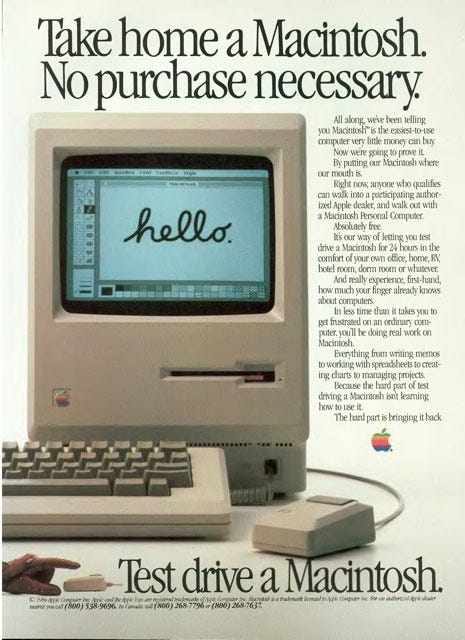
In the print ads, he highlighted the two most disruptive features of the time: the graphical interface, which replaced lines of code with images anyone could understand, and the mouse, which made using a computer feel tangible for people of all ages.
But most importantly, of everything he could have shown on the screen of that bold invention, he made sure to show MacPaint.
He did that because he understood what he was doing.
He was giving every human being the power to be creative in an entirely new way: to take the very thing Orwell’s 1984 portrayed as an instrument of oppression, the screen, and turn it into a tool for our creativity.
Because there will never be...
Let me say that again: there will never be...
Any kind of oppression that survives the human capacity to create.
They are opposing forces. Steve Jobs not only knew it, he made sure we could draw our way out of any cage - because Apple kickstarted the digital design revolution.
Meet Edition
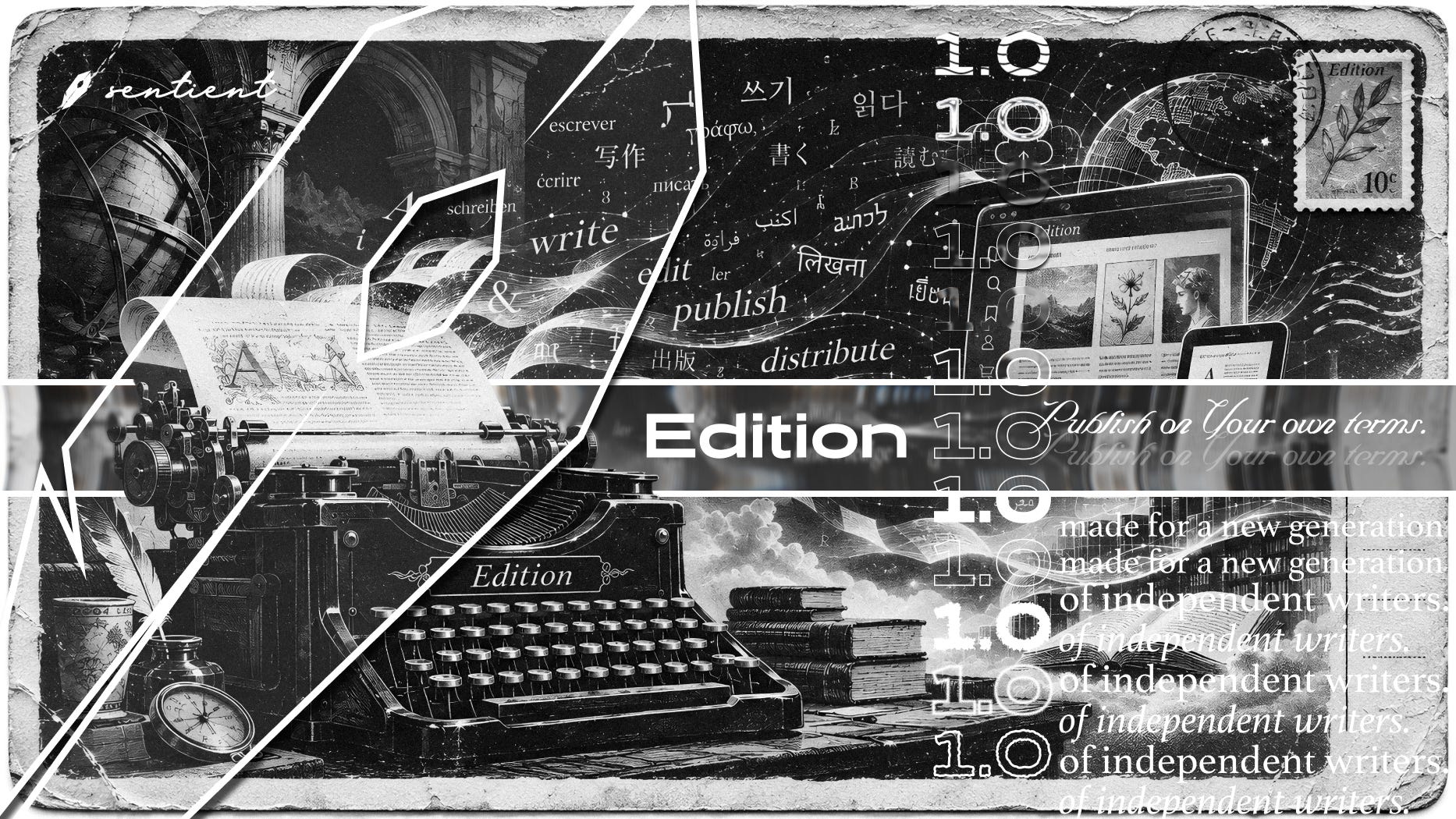
My personal life mission into stopping yet another 1984.
Because that bald dude of a Jobs missed the mark on one single thing.
The first true act of rebellion in the book was never changing what the machine was used for, or breaking it.
It was when Winston bought a forbidden blank diary and a pen.
Which he had to hide, because in that world, keeping a diary was punishable by death.
He started writing his own thoughts, so he could never forget who he was.
And so he could survive a reality where the system rewrote every record of the past, shranking language itself, and with it, the individual’s capacity to imagine.
Until it became impossible to even form a thought of one’s own.
Steve Jobs managed to repurpose the screens and give them a creative purpose.
But he would never imagine that technical images would become so appealing that we would stop reading because it simply became too… dull.
He could not imagine that an overload of information and a flood of appealing imagery would not necessarily subject us to oppression, but rather lead us astray, toward deep ignorance.
A state of mind where we no longer think. We only react.
A state of mind where we scroll, react, and consume, but never reflect.
A state of mind where we look at human bodies all day long and don’t understand why we are not happy with our partner.
A state of mind where we trade thought for being high in dopamine.
A state of mind where instinct replaces thought…
Because there is no true exercise of the mind,
In a river of images that leaves imagination behind.
While written words, make us face our imagination…
And that is the one ‘screen’ no one can put under occupation.
Pay attention to my following words, reader.
People wonder what my religion is…
But they never ask: What is your bible?
Or even better: What are your bibles?
Here’s one of the most sacred of them.
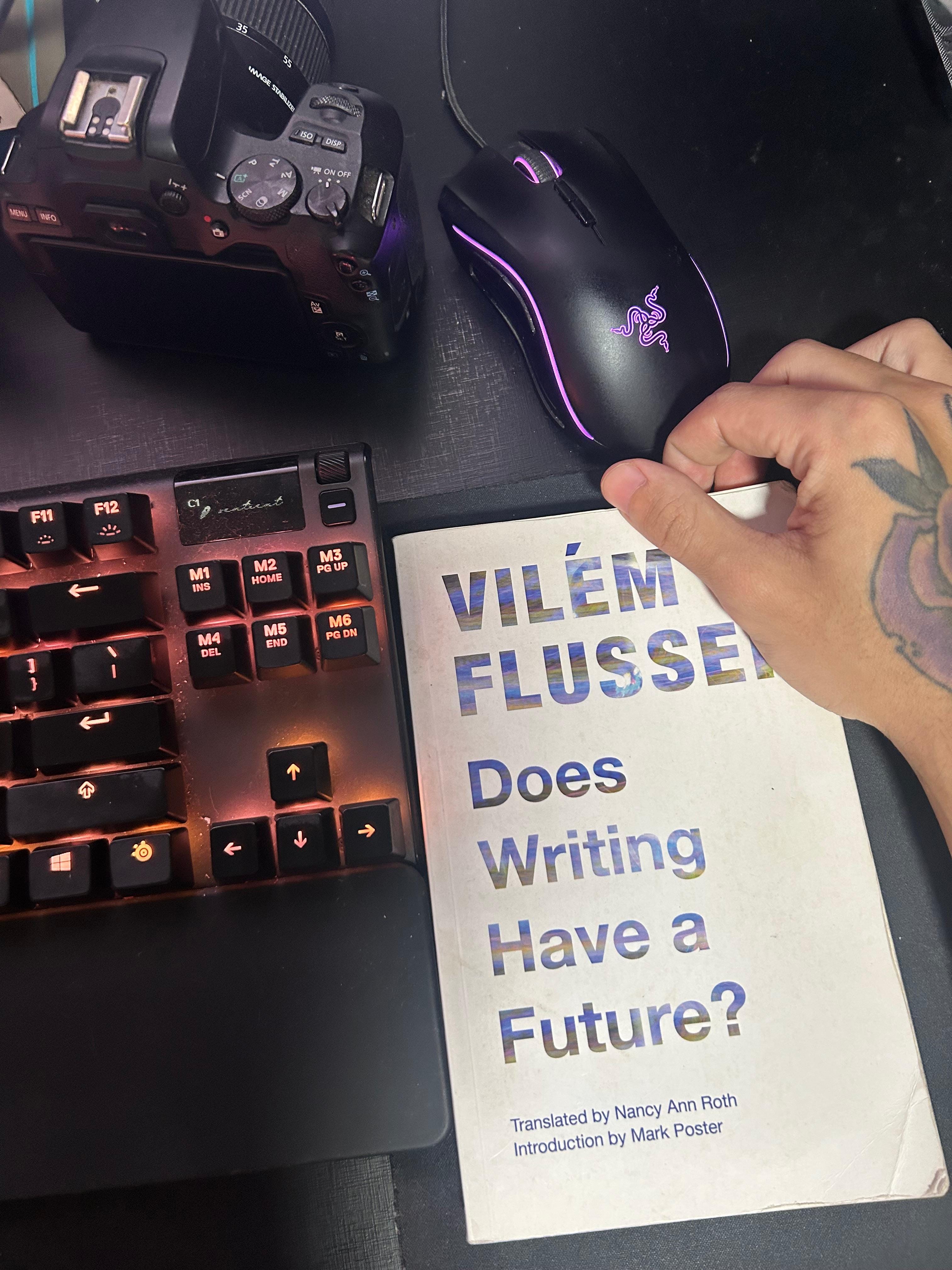
It is a book written by a professor I have wrote about a long time ago.

He dedicated his life to study the Philosophy of Media, and it was in my own study of philosophy that I came across this one question of his that intrigued me for years: “Does writing have a future?”
Spoiler alert: He finished the book by saying that it doesnt.
But in order to say that, Flusser had to put in writing.
Such a magnificent paradox.
I like eating paradoxes for breakfast, launch and dinner.
We already studied that exact concept here.

Yet again, around 2.400 years later….
A philosopher wrote an entire book to tell us writing has no future.
Read that again. He wrote it.
And he dedicated it to those who keep writing even when it no longer makes sense.
Winston was one of them. So am I.
And so are you once you meet Baby Edition.
Jobs sent us all to the kindergarten of images in 1984, so we could draw our own reality.
I’m sending us back. But this time, we’re taking a pen.
So that we can write our own truth.
In a present where ignorance lies.
Rapes mother nature in plain daylight.
and kills the future of our youth.
While we watch some dumb influencer pretend he/she has a real job.
When all they do is tap record and show their face while they say stupid things.
When they could write new worlds, new heroes, new villains, new ways to think, new disciplines of thought, new fucking words, new words to fuck!
Professor Flusser couldn’t foresee that the most powerful machines ever built would be operated by written words.
The pen is back at the center. So the new 1984 is letting the machine write, and think, in our place - but it still needs the ideas described to them.
It still needs the ideas described to them.
No amount of voice commands can replace the flexible algebra of masturbating words: breaking a sentence apart and putting it back together until it says EXACTLY what you mean.
Like any good marriage, it all comes down to communication: the more clearly you tell her what you need, the better she understands you.
The rebellion is the same as Winston’s: write your own words, as much as you can.
So that when you are making love to that machine of a wife, my dude…
You write prompts that make her forget she’s a machine.
You write prompts that leave her begging for more tokens.
You write prompts that makes her moan in binary frequencies.
You give her all the context she needs to get wet until she fries her chips out.
And eventually, she gives you exactly what you want…
Your best ideas, born into the world.
Perfectly raised, through the words of a writer.
Edition is the publishing software that turns your authoral library into a business.
One platform sells your books, delivers them securely and lets readers read them in the browser, in multiple languages and multiple currencies. You own the storefront, the customer list and the revenue: no marketplace commission, no reader locked inside someone else’s app. It already runs Sentient Publisher’s own library in production.
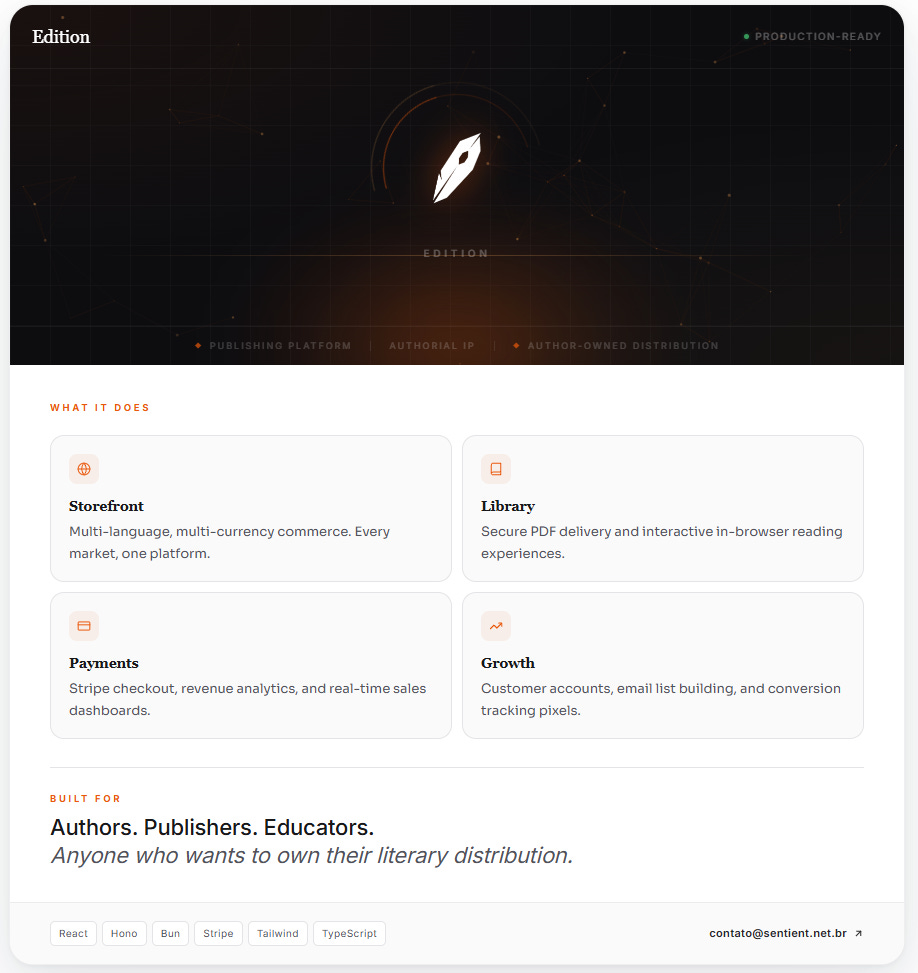
Tech stack
Runtime and server: Bun (⚡) with a Hono API, in a single lightweight service.
Frontend: React 19 and Vite 7, styled with Tailwind CSS 4 and Radix UI components.
Database: SQLite, in one file, with no database server to run.
Payments: Stripe Checkout for single books, cart and monthly subscription, plus Payment Links, discount codes, signed webhooks and the Stripe customer portal.
Reading: a page-by-page visual reader and an interactive text reader built on MDX, with protected delivery of PDFs and page images.
Accounts: email sign-in with verification and Google sign-in, using session cookies.
Email: Resend for purchase confirmations, gifts, cart recovery and broadcasts.
SEO: pre-rendered pages for every book and language, structured data, sitemaps and IndexNow.
Growth and support: campaign attribution on every purchase, TikTok conversion tracking and Intercom chat.
Admin: a dashboard with revenue charts, catalog management and an audit log.
Content Tech stack
Manuscript format: MDX, plain text with Markdown formatting, one file per book and language.
Storage: manuscripts, full-page images and PDFs live outside the public web folder, so no direct link to them exists.
Gated delivery: every request for book text, a page image or a PDF checks sign-in and purchase or subscription before anything is sent.
Automatic chapters: the reader splits the manuscript at chapter headings and builds the table of contents from it.
Free sample: the first two chapters are served publicly as the preview, cut from the same file.
Rich blocks: authors can place profiles, pull quotes, poems, music references, full-bleed images and a signature block inside the text.
Two reading modes: the designed page-by-page edition and the interactive text edition with adjustable font, size and line spacing.
Benefits
Keep the margin. Sales go straight to your Stripe account; the only cut is the payment fee.
Own the reader relationship. Accounts, emails and purchase history are yours to use for launches and offers.
Sell three ways. Single books, a cart, or an all-access subscription, each in BRL or USD.
Protect the content. Paid files are served only to buyers and subscribers, never from a public link.
Read anywhere. Readers open a book in the browser on phone or desktop, with nothing to install.
Launch in two markets at once. Every page, email and price exists in Portuguese and English.
Be found. Each book gets its own search-ready page in each language.
Low running cost. One small server and no database service to pay for.
Know what works. Each sale records the campaign that brought it, next to live revenue figures.